
Tesamorelin Research
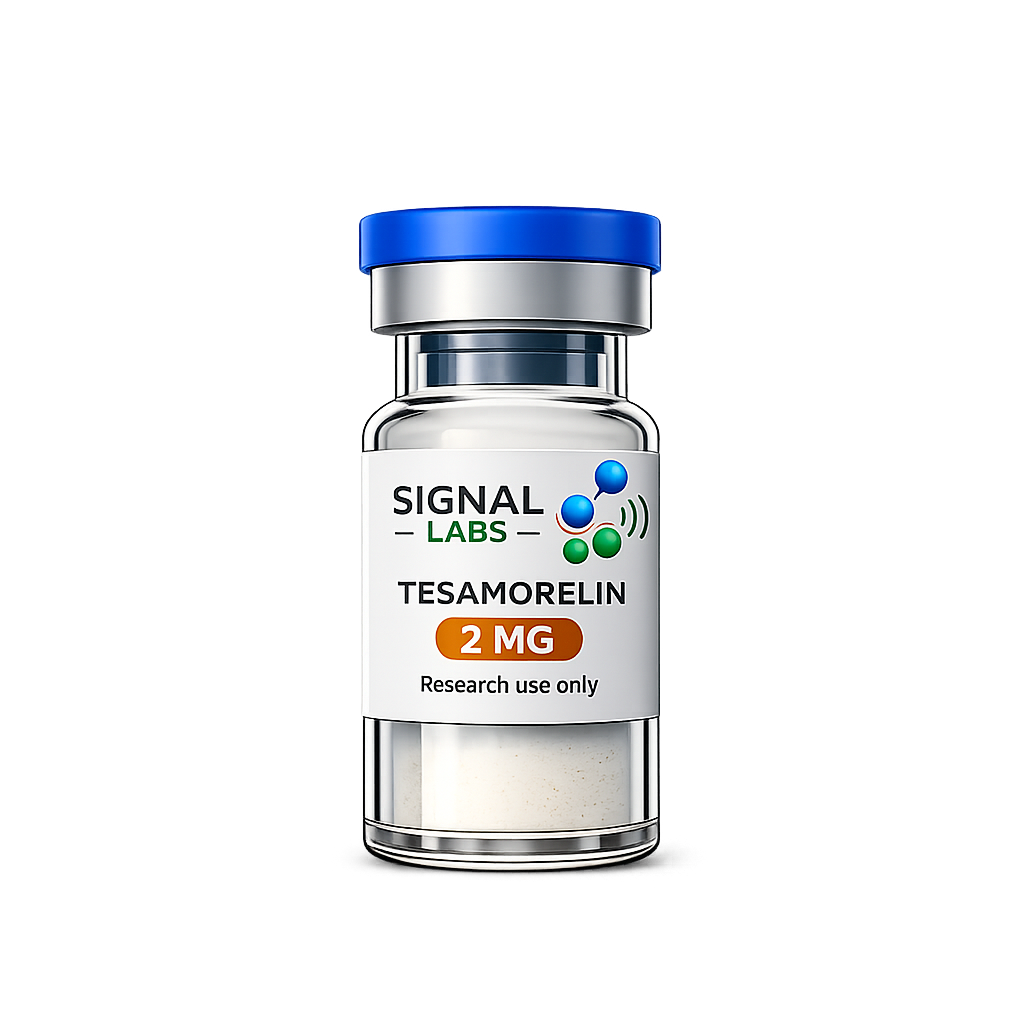
Tesamorelin: GHRH Analogue Research and GH Axis Biology
Tesamorelin is a synthetic analogue of growth hormone-releasing hormone (GHRH 1-44) studied in laboratory settings for its role in hypothalamic-pituitary signalling, growth hormone regulation research, and comparative pharmacology with shorter GHRH analogues. It represents the full-length GHRH analogue in contrast to the truncated CJC-1295 (No DAC) (GHRH 1-29 analogue).
Chemical and Molecular Data
| Property | Value |
|---|---|
| Molecular formula | C223H370N72O69 |
| Molecular weight | 5135.91 g/mol |
| CAS number | 901758-09-6 |
| Amino acid count | 44 |
| Parent peptide | GHRH(1-44) |
| Key modification | trans-3-hexenoic acid at N-terminus |
| Purity | greater than or equal to 98% as verified by HPLC |
| Form | Lyophilised powder |
| Storage | -20 degrees C, protected from light and moisture |
| Reconstitution | Bacteriostatic water recommended |
Tesamorelin vs CJC-1295 Variants: GHRH Analogue Comparison
Structural Design
Tesamorelin is identical to native GHRH(1-44) with a single modification: a trans-3-hexenoic acid group attached to the N-terminal tyrosine. This modification protects the N-terminus from DPP-IV cleavage (the primary degradation pathway for GHRH) while preserving the full receptor-binding domain. Unlike CJC-1295 variants which are based on the truncated 1-29 sequence, Tesamorelin retains all 44 amino acids of native GHRH, making it a closer structural analogue for studying the pharmacological relevance of the C-terminal GHRH domain.
GHRH Receptor Pharmacology
Tesamorelin acts at the GHRH receptor (GHRHR), a class B GPCR on pituitary somatotroph cells, through the same mechanism as native GHRH. Receptor activation couples to Gs, raises intracellular cAMP, and activates PKA, leading to GH gene transcription and GH exocytosis.
The availability of multiple GHRH analogues at Signal Labs enables comparative receptor pharmacology research: CJC-1295 (No DAC) (1-29 analogue, pulsatile half-life), CJC-1295 (With DAC) (1-29 analogue, extended albumin-bound half-life), and Tesamorelin (full 1-44 analogue) allow researchers to investigate the roles of peptide length, structural modifications, and half-life in GHRHR pharmacodynamics.
GH Axis Research Applications
Tesamorelin is used in GHRHR binding and pharmacology studies, GH pulse secretion research in animal models, comparative studies with shorter GHRH analogues (CJC-1295 No DAC and With DAC), IGF-1 axis research in conjunction with IGF-1 LR3, and pituitary somatotroph cell biology studies.
GHRH Analogue Comparison
| Property | Sermorelin | CJC-1295 No DAC | Tesamorelin | CJC-1295 With DAC |
|---|---|---|---|---|
| Sequence | GHRH(1-29)-NH2 | GHRH(1-29) modified | GHRH(1-44) modified | GHRH(1-29) + DAC |
| Length | 29aa | 29aa | 44aa | 29aa |
| DPP-IV resistance | Partial (C-term amide) | Full (D-Ala2) | Full (N-term modification) | Full |
| Albumin binding | No | No | No | Covalent |
| Half-life | ~10-20 min | ~30 min | ~30 min | ~8 days |
| GH pattern | Pulsatile | Pulsatile | Pulsatile | Sustained |
Frequently Asked Questions
What is the significance of the trans-3-hexenoic acid modification at Tesamorelin's N-terminus?
Native GHRH(1-44) has a tyrosine at position 1 (Tyr1). DPP-IV cleaves dipeptides from the N-terminus and is responsible for rapid inactivation of GHRH and many other neuropeptides. The trans-3-hexenoic acid group attached to Tyr1 in Tesamorelin sterically blocks DPP-IV access to the N-terminal bond, conferring resistance to this primary degradation mechanism. Unlike CJC-1295's D-Ala2 substitution (which replaces the cleavage site entirely), Tesamorelin protects the natural amino acid sequence while adding a protective N-terminal cap. This makes Tesamorelin particularly useful as a research tool when the authentic GHRH(1-44) sequence is required with improved stability.
Why retain all 44 amino acids in Tesamorelin rather than using the truncated 1-29 sequence?
GHRH(1-29) (the sequence used in CJC-1295 variants and Sermorelin) retains full GHRHR binding activity — the first 29 amino acids contain the complete receptor pharmacophore. The additional 15 C-terminal residues (positions 30-44) do not appear to contribute to receptor binding but may have roles in peptide conformation and stability. Tesamorelin represents the full-length GHRH analogue for research settings where comparison with native-length GHRH is important, or where the authentic C-terminal region needs to be present for structural studies.
How does Tesamorelin research complement IGF-1 LR3 research?
Tesamorelin stimulates pituitary GH secretion via GHRHR, which in turn drives hepatic IGF-1 production and release. IGF-1 LR3 allows direct activation of the IGF-1 receptor independently of upstream GH axis stimulation. Using both together allows researchers to study the GH-IGF-1 axis at two distinct levels: at the pituitary (via GHRHR with Tesamorelin) and at peripheral IGF-1R (directly with IGF-1 LR3), with the ability to dissect which effects are GH-dependent versus IGF-1R-mediated.
Published Research References
For laboratory and analytical research purposes only. Not for human or veterinary use. No dosage or administration guidance is provided or implied.
Related research peptides: CJC-1295 (No DAC) | CJC-1295 (With DAC) | IGF-1 LR3 | Ipamorelin
Full-Length GHRH: What Positions 30-44 Contribute
Tesamorelin preserves the complete GHRH(1-44) sequence with only the N-terminal trans-3-hexenoic acid modification for DPP-IV protection. This makes it pharmacologically distinct from Sermorelin (GHRH 1-29) and CJC-1295 variants (GHRH 1-29 with modifications) by retaining the authentic C-terminal 15 residues.
Published structure-activity relationship data on GHRH has established that the first 29 amino acids contain the complete receptor pharmacophore — positions 30-44 are not required for GHRHR binding or activation. However, the C-terminal extension is not pharmacologically inert. Published research has examined whether the C-terminal region influences: peptide secondary structure and stability (positions 30-44 form an alpha-helical extension that may stabilise the N-terminal receptor-binding helix), potential interactions with heparan sulphate proteoglycans on cell surfaces (several basic residues in positions 30-44 could promote HSPG binding), and possible binding to secondary GHRH-binding sites distinct from the orthosteric GHRHR site.
For researchers comparing GHRH analogues across the full sequence spectrum — Sermorelin (1-29 unmodified), CJC-1295 No DAC (1-29 with 4 modifications), and Tesamorelin (1-44 with N-terminal cap) — Tesamorelin provides the authentic full-length reference point.
Visceral Fat Research Context
Tesamorelin's clinical approval (as Egrifta) for HIV-associated lipodystrophy provides an unusually rich published dataset for a GHRH research analogue. The clinical research established that Tesamorelin-driven GH axis stimulation selectively reduces visceral adipose tissue (VAT) more than subcutaneous adipose tissue (SAT) — a pharmacological selectivity proposed to reflect the high density of GH receptors in visceral fat depots and their greater sensitivity to GH-mediated lipolysis versus subcutaneous fat.
For laboratory researchers studying adipose tissue GH responsiveness, the published Tesamorelin clinical data (Falutz et al., NEJM 2007; Stanley et al., multiple publications) provides a framework for contextualising in vitro findings on GH receptor expression, GH-induced lipolysis, and adipose depot-specific GH sensitivity.
Frequently Asked Questions
How does Tesamorelin's clinical approval affect its research classification?
Tesamorelin (Egrifta) is an FDA-approved pharmaceutical for HIV-associated lipodystrophy — one of the few GHRH analogues with regulatory approval. For laboratory research purposes, Tesamorelin is supplied as a research compound at greater than or equal to 98% purity for in vitro and preclinical mechanistic studies. The clinical approval provides an extensive published pharmacology dataset that makes Tesamorelin particularly useful as a reference compound for GHRH biology research, as its receptor pharmacology, pharmacokinetics, and downstream GH/IGF-1 effects have been characterised in published human studies.
What distinguishes Tesamorelin's GH pulse profile from CJC-1295 No DAC?
Both compounds have plasma half-lives of approximately 30 minutes, producing pulsatile GH release of similar duration. The key difference is sequence: Tesamorelin presents the authentic GHRH(1-44) pharmacophore to GHRHR, while CJC-1295 No DAC presents the modified GHRH(1-29) pharmacophore. For research specifically examining the pharmacology of the native full-length GHRH sequence, Tesamorelin is the appropriate tool. For research requiring maximally stable pulsatile GHRH stimulation with a shorter, well-characterised pharmacophore, CJC-1295 No DAC is preferred.
Browse all Signal Labs research peptides | Peptide storage guide | Reconstitution guide