
TB-500 Thymosin Beta-4 Research: Molecular Data and Laboratory Use | Signal Labs
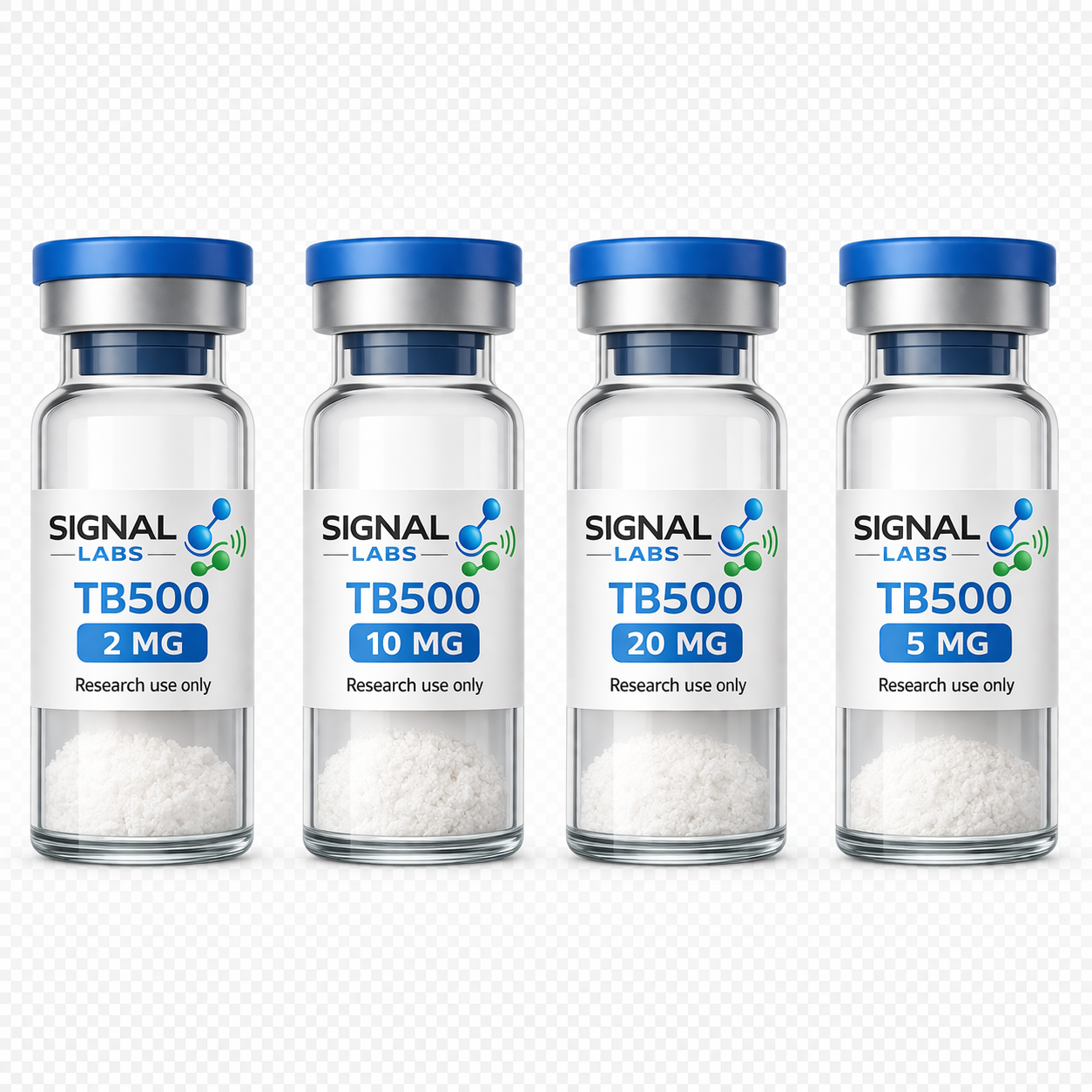
TB-500 (Thymosin Beta-4): Research Profile and Laboratory Applications
TB-500 is a synthetic analogue of Thymosin Beta-4 (Tb4), a naturally occurring 43 amino acid peptide encoded by the TMSB4X gene. It is one of the most abundant intracellular peptides found in mammalian cells and plays a central role in actin dynamics and cytoskeletal organisation. Research interest spans wound healing biology, cardiac research, corneal repair, and neurological models.
Chemical and Molecular Data
| Property | Value |
|---|---|
| Molecular formula | C212H350N56O78S |
| Molecular weight | 4963.5 g/mol |
| CAS number | 77591-33-4 |
| Gene | TMSB4X |
| Chromosome | X-linked |
| Amino acid count | 43 |
| Purity | greater than or equal to 98% as verified by HPLC |
| Form | Lyophilised powder |
| Storage | -20 degrees C, protected from light and moisture |
| Reconstitution | Bacteriostatic water recommended |
TB-500: Actin Dynamics and Research Targets
The LKKTET Actin-Binding Motif
The defining structural feature of TB-500 is the LKKTET actin-binding motif located at positions 17-22. This hexapeptide binds monomeric G-actin with high affinity and has been studied extensively in isolation as well as within the full 43-mer sequence.
Actin exists in two primary cellular forms: monomeric G-actin (globular) and polymerised F-actin (filamentous). The balance between these forms, known as the G/F-actin ratio, is tightly regulated and critical for cell morphology, migration, and division. TB-500, through its LKKTET motif, sequesters G-actin monomers, controlling the pool of actin available for filament polymerisation.
This G-actin sequestering activity places TB-500 in related research territory to BPC-157, which also influences actin cytoskeletal organisation through FAK-paxillin signalling rather than direct actin binding.
Cell Migration and Wound Healing Research
Laboratory research has examined TB-500 extensively in cell migration models. Studies have examined fibroblast directional migration (a key process in dermal wound healing), endothelial cell tube formation assays examining potential roles in angiogenesis, and keratinocyte migration in monolayer scratch models.
Cardiac Research
One of the most prominent areas of TB-500 research involves cardiac cell biology. Seminal work published in Nature in 2007 showed epicardial progenitor cell mobilisation in response to Thymosin Beta-4. Research has examined cardiomyocyte survival signalling in hypoxia/reoxygenation models, vascular progenitor cell differentiation, and Tb4 expression following experimental cardiac ischaemia.
Corneal and Ocular Research
Thymosin Beta-4 is expressed at high levels in the corneal epithelium. Laboratory studies have examined corneal epithelial cell migration following mechanical injury, inflammatory mediator expression in corneal tissue, and tear film composition in animal models of ocular surface disease.
Research Applications
TB-500 is used as a tool compound in laboratory settings examining actin dynamics and cytoskeletal biology, cell migration in scratch and transwell assays, angiogenesis and tube formation models, cardiac cell survival and differentiation, and corneal epithelial biology.
Frequently studied alongside BPC-157 (NO-related signalling), MOTS-c (mitochondrial metabolic signalling), and Ipamorelin (GH axis research).
Storage and Handling
Store at -20 degrees C in a desiccated environment, protected from light and moisture. Reconstitute with bacteriostatic water. Stable in lyophilised form for extended periods when stored correctly. Soluble in aqueous solution at physiological pH. Avoid repeated freeze-thaw cycles.
Comparison: TB-500 vs BPC-157 in Actin and Migration Research
| Property | TB-500 (Thymosin Beta-4) | BPC-157 |
|---|---|---|
| Amino acids | 43 | 15 |
| Actin mechanism | Direct G-actin binding (LKKTET) | FAK-paxillin pathway |
| Key motif | LKKTET (positions 17-22) | Pro-Pro-Pro (positions 3-5) |
| Primary research | Actin dynamics, cardiac, corneal | NO signalling, GI, neurochemistry |
| Gene | TMSB4X (X-linked) | Synthetic — gastric BPC-derived |
| CAS | 77591-33-4 | 137525-51-0 |
Frequently Asked Questions
What is the LKKTET motif and why does it matter in TB-500 research?
The LKKTET hexapeptide sequence at positions 17-22 of Thymosin Beta-4 is the primary G-actin binding domain. This six amino acid sequence binds monomeric G-actin with high affinity, sequestering it from the pool available for F-actin polymerisation. The LKKTET motif has been studied extensively in isolation as well as within the full 43-mer TB-500 sequence, and it forms the mechanistic basis for TB-500's role in actin dynamics research.
How does TB-500 relate to ghrelin or GH axis research?
TB-500 does not directly interact with the GH axis. Its primary mechanism is through actin cytoskeletal biology. Researchers studying tissue repair who also investigate GH axis signalling may use TB-500 alongside Ipamorelin or CJC-1295 (No DAC), but these operate through entirely distinct receptor systems.
What cell types are most commonly used in TB-500 laboratory research?
Published laboratory research on Thymosin Beta-4 has used fibroblasts (wound healing scratch assays), endothelial cells (tube formation and migration assays), cardiomyocytes and epicardial progenitor cells (cardiac research models), corneal epithelial cells (ocular surface research), and neural progenitor cells (neurological injury models).
How should TB-500 be stored and reconstituted?
Store lyophilised at -20°C in a desiccated, light-protected environment. Reconstitute with bacteriostatic water. TB-500 is soluble at physiological pH. Aliquot reconstituted solution to avoid repeated freeze-thaw cycles. The peptide is stable in lyophilised form for extended periods under correct storage conditions.
Published Research References
For laboratory and analytical research purposes only. Not for human or veterinary use. No dosage or administration guidance is provided or implied.
Related research peptides: BPC-157 | Ipamorelin | MOTS-c | CJC-1295 (No DAC)
ILK Activation: The Second TB-500 Mechanism
Beyond actin sequestration, published research has identified a second biological activity of Thymosin Beta-4: activation of integrin-linked kinase (ILK). ILK is a pseudokinase that forms a ternary complex with PINCH (particularly interesting new cysteine-histidine rich protein) and parvin (alpha or beta) at focal adhesion sites. This ILK-PINCH-parvin (IPP) complex connects integrin cytoplasmic tails to the actin cytoskeleton and to downstream signalling pathways including PI3K/Akt.
Bock-Marquette et al. (Nature, 2004) published that Thymosin Beta-4 could directly bind and activate ILK, independent of its actin-sequestering LKKTET activity. ILK activation by Thymosin Beta-4 promotes Akt phosphorylation at Ser473 (survival signalling) and drives cell migration through PI3K-dependent mechanisms distinct from the LKKTET/actin pathway. This dual mechanism — LKKTET actin sequestration and ILK activation — provides TB-500 with two complementary routes to influencing cell migration and survival biology.
Corneal Epithelial Biology
The corneal epithelium is one of the highest-expressing tissues for Thymosin Beta-4 in the body. This expression pattern connects TB-500 directly to corneal epithelial research. Published studies have examined Thymosin Beta-4 in corneal wound healing models including: scratch assay migration of human corneal epithelial cells (HCECs), corneal re-epithelialisation after alkali injury in animal models, and dry eye disease models where corneal epithelial integrity is compromised.
The mechanistic basis for TB-500's role in corneal biology involves both its actin dynamics effects on epithelial cell migration (lamellipodia formation for re-epithelialisation) and its anti-inflammatory properties through suppression of inflammatory cytokine production in corneal stroma. This multi-mechanism profile makes TB-500 a research tool at the intersection of corneal cell biology and ocular inflammation research.
Frequently Asked Questions
What is the relationship between TB-500 and full-length Thymosin Beta-4?
TB-500 is a synthetic analogue of the 43 amino acid Thymosin Beta-4 (Tb4) peptide encoded by the TMSB4X gene. It reproduces the complete Tb4 sequence with equivalent actin-sequestering and ILK-activating biological activities in research models. Full-length recombinant Thymosin Beta-4 is also available as a research tool, but TB-500 as a synthetic peptide provides consistent batch-to-batch composition verified by HPLC, which is more tractable for quantitative research than protein-based preparations where post-translational modifications and aggregation can introduce variability.
How is the G/F-actin ratio measured in TB-500 research?
The standard method is the Triton X-100 solubility fractionation assay: cells are lysed in buffer containing Triton X-100, which solubilises G-actin (monomeric, cytosolic) while leaving F-actin (polymerised, cytoskeletal) insoluble. Centrifugation separates the G-actin-containing supernatant from the F-actin-containing pellet. Both fractions are analysed by Western blot with anti-actin antibody, and the G/F ratio is calculated from band densitometry. TB-500 treatment typically increases the G/F ratio (more G-actin, less F-actin) in treated cells versus controls.
Browse all Signal Labs research peptides | Peptide storage guide | Reconstitution guide
TB500 (the common shorthand for TB-500) is one of the most researched tissue repair peptides available from Signal Labs for laboratory research purposes. Researchers searching for TB500 UK or TB-500 UK will find Signal Labs supplies HPLC verified TB-500 at ≥98% purity with tracked UK dispatch.