
SLU-PP-332 Research: ERR Agonist and Mitochondrial Biogenesis | Signal Labs
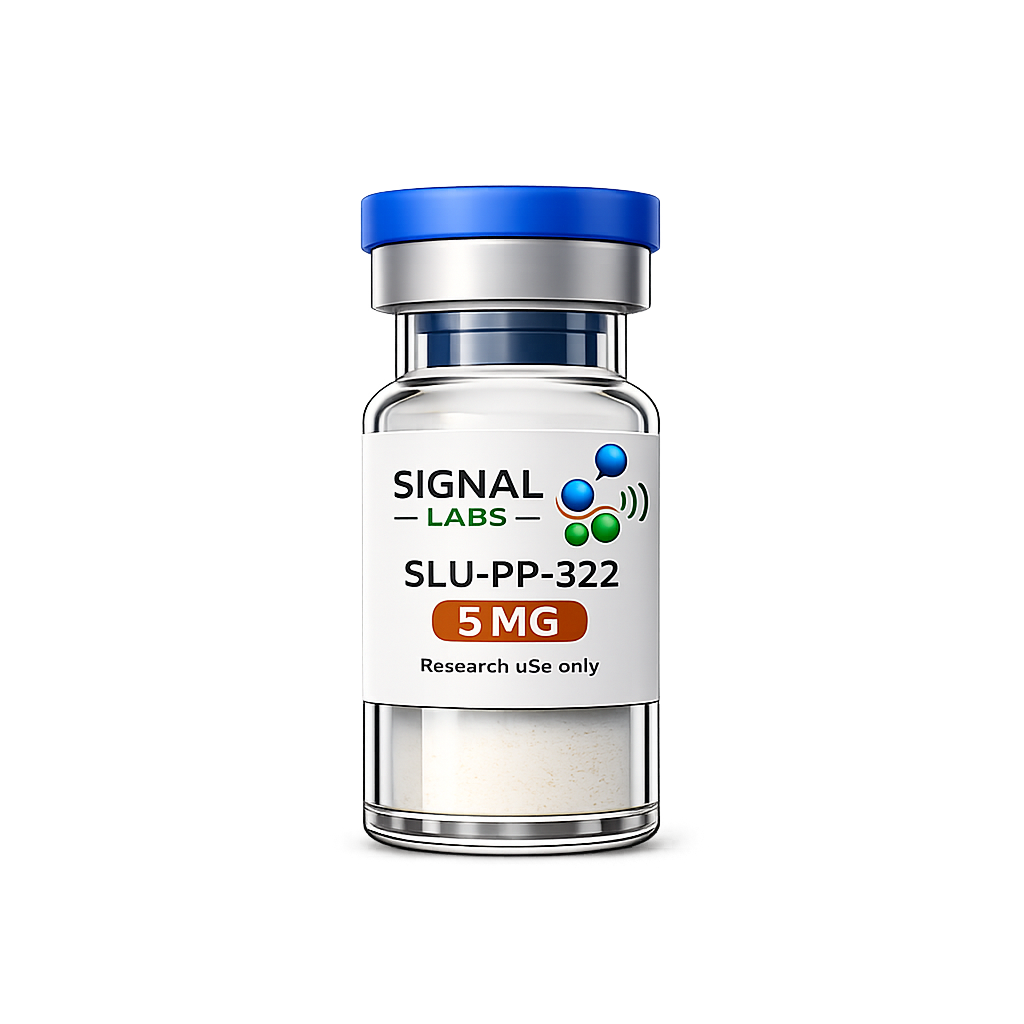
SLU-PP-332: Pan-ERR Agonist and Mitochondrial Biogenesis Research
SLU-PP-332 is a synthetic small molecule studied in laboratory settings as a selective pan-agonist of the oestrogen-related receptors (ERRalpha, ERRbeta, ERRgamma). These nuclear receptors are master regulators of mitochondrial biogenesis, oxidative metabolism, and energy homeostasis, making SLU-PP-332 a valuable research tool in metabolic biology, cardiac physiology, and exercise science research.
Chemical and Molecular Data
| Property | Value |
|---|---|
| Molecular formula | C24H18F3N3O2S |
| Molecular weight | 489.48 g/mol |
| CAS number | 2366993-16-8 |
| Target receptors | ERRalpha, ERRbeta, ERRgamma |
| Drug class | Nuclear receptor agonist (pan-ERR) |
| Purity | greater than or equal to 98% as verified by HPLC |
| Form | Lyophilised powder |
| Storage | -20 degrees C, protected from light and moisture |
| Reconstitution | DMSO recommended (poor aqueous solubility) |
SLU-PP-332: Pan-ERR Agonism
Oestrogen-Related Receptors: Background
The ERRs were identified based on structural homology to oestrogen receptors but do not bind oestrogen or other steroid hormones. They are constitutively active transcription factors regulated primarily through co-activator and co-repressor interactions rather than ligand binding. All three ERR isoforms bind the ERR response element (ERRE), a half-site motif TNAAGGTCA, in the promoters of target genes.
ERRalpha: Mitochondrial Biogenesis and Oxidative Metabolism
ERRalpha is the most extensively studied ERR isoform and is considered a master regulator of mitochondrial biogenesis. It is expressed at highest levels in tissues with high energy demands including heart, skeletal muscle, brain, and brown adipose tissue.
ERRalpha works in concert with PGC-1alpha, the acknowledged master regulator of mitochondrial biogenesis. The ERRalpha/PGC-1alpha complex regulates nuclear-encoded mitochondrial genes, oxidative phosphorylation (OXPHOS) subunit expression, fatty acid oxidation enzyme expression, and TCA cycle enzyme expression. ERRalpha target gene expression increases substantially following aerobic exercise, making SLU-PP-332 relevant to exercise mimetic research.
ERRbeta: Developmental and Stem Cell Biology
ERRbeta has a more restricted expression pattern, with high expression during embryonic development. Research has examined it in embryonic stem cell pluripotency maintenance, trophoblast differentiation, and inner ear and retinal development.
ERRgamma: Cardiac Metabolism
ERRgamma is the predominant ERR isoform in the adult heart, regulating the metabolic switch between glucose and fatty acid oxidation in cardiomyocytes, a switch disrupted in heart failure and diabetic cardiomyopathy.
Research Connections
SLU-PP-332 research intersects with NAD+ and sirtuin biology (PGC-1alpha is deacetylated and activated by SIRT1 in an NAD+-dependent manner, upstream of ERR co-activation), MOTS-c and AMPK pathway (AMPK activation phosphorylates and activates PGC-1alpha, which in turn co-activates ERRalpha), and 5-Amino-1MQ (NNMT inhibition alters NAD+ availability and SAM methylation status, upstream of sirtuin activity and PGC-1alpha acetylation).
Research Applications
SLU-PP-332 is used in ERR reporter gene assays (luciferase-based transcriptional activation), mitochondrial biogenesis studies (mtDNA copy number, OXPHOS protein expression), fatty acid oxidation assays in C2C12, primary myocytes, or hepatic cell lines, comparison with PGC-1alpha overexpression models, exercise mimetic research paradigms, and cardiac metabolism research in cardiomyocyte cultures.
Storage and Handling
Prepare stock solutions in DMSO (typically 10-50 mM) and store as aliquots at -20 degrees C. Dilute freshly prepared stock in aqueous buffer immediately before use; maintain DMSO at 0.1% or less in cell assays. SLU-PP-332 has poor aqueous solubility, do not add powder directly to aqueous media.
ERR Isoform Comparison
| Property | ERRalpha | ERRbeta | ERRgamma |
|---|---|---|---|
| Gene | ESRRA | ESRRB | ESRRG |
| Primary tissue | Heart, muscle, BAT, brain | Embryo, placenta, inner ear | Heart, brain, kidney |
| Key co-activator | PGC-1alpha | PGC-1beta | PGC-1alpha |
| Primary research area | Mitochondrial biogenesis, OXPHOS | Stem cell pluripotency | Cardiac FA oxidation |
| Exercise response | Strong upregulation | Limited data | Moderate |
| SLU-PP-332 activity | Full agonist | Full agonist | Full agonist |
Frequently Asked Questions
What does it mean that ERRs are orphan nuclear receptors?
Orphan nuclear receptors are members of the nuclear receptor superfamily for which no natural ligand has been identified — they were discovered based on structural homology to known ligand-activated receptors (in ERRs' case, the oestrogen receptors ERalpha and ERbeta) but do not respond to the known ligands of those receptors. ERRs are constitutively active — they do not require a ligand to fold into their active conformation. Their activity is instead regulated by interactions with co-activators (primarily PGC-1alpha, PGC-1beta) and co-repressors. SLU-PP-332 acts as a synthetic agonist that enhances ERR transcriptional activity even though ERRs have no known endogenous ligand.
Why does SLU-PP-332 require DMSO for preparation?
SLU-PP-332 has poor aqueous solubility due to its aromatic trifluoromethyl-containing structure (C24H18F3N3O2S). It should be dissolved in DMSO to prepare a concentrated stock (10-50 mM) which is then diluted into aqueous buffer immediately before use. Maintain DMSO concentration at 0.1% or below in cell-based assays. Do not add the powder directly to aqueous media — it will not dissolve and will appear as particulates that can clog pipettes and affect assay results.
How does SLU-PP-332 compare to PGC-1alpha overexpression as a research tool?
PGC-1alpha overexpression (via adenoviral or lentiviral vectors, or transgenic models) activates all PGC-1alpha target pathways simultaneously, including all ERR isoforms, PPARs, and other co-activated transcription factors. SLU-PP-332 provides more targeted activation — it specifically agonises ERR receptors without necessarily affecting other PGC-1alpha targets. This makes it a useful tool for dissecting which aspects of PGC-1alpha-driven transcription are specifically ERR-mediated. Researchers often use both approaches in parallel to compare ERR-specific effects with the broader PGC-1alpha programme.
Published Research References
For laboratory and analytical research purposes only. Not for human or veterinary use. No dosage or administration guidance is provided or implied.
Related research compounds: MOTS-c | NAD+ | 5-Amino-1MQ
ERRalpha and the PGC-1alpha Co-activation Network
ERRalpha (encoded by ESRRA) operates within a co-activation network centred on PGC-1alpha. PGC-1alpha itself is not a DNA-binding transcription factor but a transcriptional co-activator that binds and activates multiple transcription factors including ERRalpha, PPARalpha, PPARgamma, and NRF1/NRF2 (nuclear respiratory factors). The ERRalpha-PGC-1alpha complex drives expression of genes encoding: OXPHOS subunits (NDUFB5, SDHA, ATP5A), fatty acid oxidation enzymes (HADHA, ACADM, HADHB), TCA cycle enzymes (IDH3A, OGDH), and mitochondrial import machinery (TIMM proteins).
SLU-PP-332 as an ERRalpha agonist stabilises the active conformation of ERRalpha's ligand-binding domain, promoting co-activator recruitment (PGC-1alpha, SRC-1, SRC-3) and enhancing transcriptional output from ERRalpha target gene promoters. This can be measured using ERR-responsive luciferase reporter constructs (ERRE-luciferase), quantitative PCR of target genes, and mitochondrial biogenesis markers (mtDNA copy number, TFAM expression, respiratory complex protein levels).
ERRgamma in Cardiac Metabolism Research
While ERRalpha is the primary focus of metabolic research in skeletal muscle and adipose tissue, ERRgamma (encoded by ESRRG) is the dominant ERR isoform in adult cardiac tissue. Cardiac energy metabolism is approximately 60-70% dependent on fatty acid oxidation and 30-40% on glucose oxidation under normal conditions. Heart failure is associated with a metabolic shift away from fatty acid oxidation toward glucose — a reversion to a more foetal metabolic programme that reduces energetic efficiency.
ERRgamma regulates fatty acid oxidation genes in the heart. SLU-PP-332's pan-ERR agonism activates ERRgamma alongside ERRalpha, making it relevant for cardiac metabolism research. Published studies using ERRgamma knockout mice have demonstrated reduced cardiac OXPHOS capacity and impaired fatty acid oxidation, while ERRgamma overexpression enhances cardiac mitochondrial biogenesis. SLU-PP-332 provides a pharmacological tool to study ERRgamma agonism in cardiac cell models including HL-1 cardiomyocytes and primary neonatal cardiomyocytes.
Frequently Asked Questions
Why is SLU-PP-332 described as a pan-ERR agonist rather than ERRalpha-selective?
ERRalpha, ERRbeta, and ERRgamma share highly conserved ligand-binding domains, making development of subtype-selective synthetic agonists challenging. SLU-PP-332 was optimised for ERRalpha but also potently activates ERRbeta and ERRgamma due to this structural conservation. This pan-ERR activity is a research tool advantage when the goal is maximal ERR-driven transcriptional output (such as maximal mitochondrial biogenesis), but complicates attribution of effects to specific ERR subtypes. Researchers requiring ERR subtype attribution should combine SLU-PP-332 treatment with subtype-selective siRNA knockdown.
How does ERR agonism differ from direct mitochondrial biogenesis stimulation?
ERR agonism acts at the nuclear transcription level, driving expression of the nuclear-encoded mitochondrial genes. This produces a sustained increase in mitochondrial biogenesis that requires hours to days for detectable changes in mitochondrial protein levels and mtDNA copy number. By contrast, direct mitochondrial interventions (like SS-31's cardiolipin interaction or MOTS-c's AMPK pathway) act on existing mitochondrial machinery with more acute effects. SLU-PP-332 is best suited for studies examining chronic mitochondrial biogenesis programmes rather than acute mitochondrial function changes.
Browse all Signal Labs research peptides | Peptide storage guide | Reconstitution guide