
Retatrutide Research: Triple Receptor Agonist Molecular Profile | Signal Labs
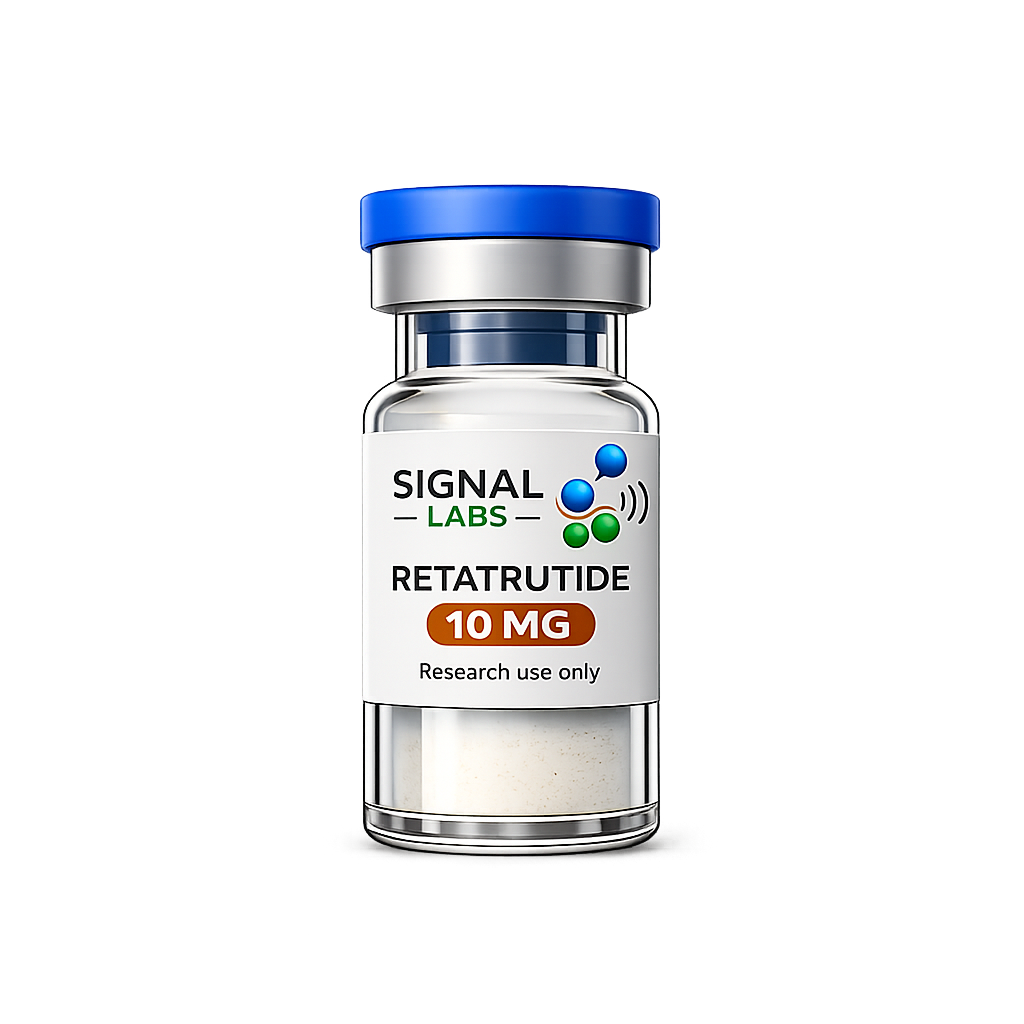
Retatrutide: Triple GLP-1/GIP/Glucagon Receptor Agonist Research
Retatrutide (LY3437943) is a synthetic fatty-acid-modified peptide that simultaneously activates GLP-1R, GIPR, and the glucagon receptor (GCGR). It represents the latest generation in incretin pharmacology research, extending the dual agonist approach of tirzepatide to encompass all three major receptors of the glucagon peptide family.
Chemical and Molecular Data
| Property | Value |
|---|---|
| Molecular formula | C222H376N68O65S2 |
| Molecular weight | 4967.6 g/mol |
| CAS number | 2381089-83-2 |
| Also known as | LY3437943 |
| Drug class | Triple incretin receptor agonist |
| Purity | greater than or equal to 98% as verified by HPLC |
| Form | Lyophilised powder |
| Storage | -20 degrees C, protected from light and moisture |
| Reconstitution | Bacteriostatic water recommended |
Retatrutide: Triple Incretin Receptor Agonism
Structural Features and Albumin Binding
Retatrutide is a fatty-acid-modified peptide designed for extended plasma half-life through reversible non-covalent albumin binding, similar in concept to the covalent DAC technology used in CJC-1295 (With DAC) but via hydrophobic rather than covalent interaction. The effective plasma half-life is approximately 6 days. The peptide backbone is based on glucagon, with sequence modifications achieving balanced agonism across all three target receptors.
GLP-1 Receptor Pharmacology
GLP-1R is a class B GPCR coupled to Gs, activating adenylyl cyclase and cAMP/PKA pathways. In pancreatic beta cells this promotes glucose-dependent insulin secretion. In the hypothalamus GLP-1R activation reduces food intake. Gastric GLP-1R activation slows gastric emptying. GLP-1R pharmacology is well characterised through liraglutide, semaglutide, and exendin-4.
GIP Receptor Pharmacology
The GIPR has a complex profile: both agonism and antagonism have been studied in metabolic disease models with different outcomes by tissue and experimental context. Research with tirzepatide demonstrated that GIPR co-agonism potentiates GLP-1R-mediated metabolic benefits, likely through central nervous system GIPR expression in the hypothalamus where it acts synergistically with GLP-1R signalling.
Glucagon Receptor Pharmacology
GCGR agonism is studied for its effects on hepatic glucose output, glycogenolysis, fatty acid oxidation, and thermogenesis. The rationale for including GCGR agonism is that beneficial energy expenditure and hepatic fat metabolism effects, balanced by GLP-1R and GIPR-mediated glucose control, produce net metabolic benefit.
Research Applications
Retatrutide is used as a tool compound for comparative receptor pharmacology studies, metabolic signalling pathway research, and incretin biology investigations. It is studied comparatively with semaglutide (GLP-1R monoagonist), tirzepatide (dual GLP-1R/GIPR agonist), and native glucagon for dissecting GCGR contributions.
Incretin Receptor Agonist Comparison
| Compound | GLP-1R | GIPR | GCGR | Half-life | Generation |
|---|---|---|---|---|---|
| Exendin-4 | Full agonist | — | — | ~2.4 hours | 1st |
| Liraglutide | Full agonist | — | — | ~13 hours | 2nd |
| Semaglutide | Full agonist | — | — | ~7 days | 3rd |
| Tirzepatide | Partial/biased | Full agonist | — | ~5 days | 4th |
| Retatrutide | Agonist | Agonist | Agonist | ~6 days | 5th |
Frequently Asked Questions
What distinguishes Retatrutide from Tirzepatide in receptor pharmacology research?
The addition of glucagon receptor (GCGR) agonism is the defining pharmacological distinction. Tirzepatide is a dual GLP-1R/GIPR agonist — Retatrutide extends this to simultaneous triple receptor agonism. The GCGR component adds hepatic glucose output effects, thermogenesis stimulation, and fatty acid oxidation enhancement to the GLP-1R/GIPR-mediated insulin secretion and appetite regulation profile. Research using both compounds together allows investigation of the incremental contribution of GCGR agonism to overall metabolic signalling.
How is Retatrutide's albumin binding achieved?
Retatrutide incorporates a fatty acid chain that enables high-affinity non-covalent binding to serum albumin through hydrophobic interactions. This is mechanistically similar to the fatty acid approach used in semaglutide and liraglutide, and distinct from the covalent thioether bond used in CJC-1295 (With DAC)'s Drug Affinity Complex (DAC) technology. The non-covalent albumin binding extends the effective plasma half-life to approximately 6 days.
What research models are most relevant for Retatrutide studies?
Relevant laboratory models for Retatrutide research include: pancreatic beta cell models for GLP-1R-mediated insulin secretion; hypothalamic cell lines or primary neurons for central appetite regulation; hepatocyte models for GCGR-mediated glucose output and fatty acid metabolism; and adipocyte cell culture for GIPR and GLP-1R signalling in fat tissue. Comparative receptor binding assays with radiolabelled ligands are also used to characterise Retatrutide's affinity and selectivity profile across the three target receptors.
Published Research References
For laboratory and analytical research purposes only. Not for human or veterinary use. No dosage or administration guidance is provided or implied.
Related research peptides: Ipamorelin | CJC-1295 (No DAC) | MOTS-c
Triple Receptor Pharmacology: The GCGR Contribution
The addition of glucagon receptor (GCGR) agonism to the dual GLP-1R/GIPR pharmacology of Tirzepatide is Retatrutide's defining feature. The GCGR is a class B GPCR that couples to Gs, activating cAMP/PKA in hepatocytes. Classical GCGR pharmacology in the liver drives: glycogenolysis (glycogen → glucose), gluconeogenesis (amino acids, lactate, glycerol → glucose), and fatty acid oxidation (through CPT1 induction by PKA and PPARalpha activation).
The apparent paradox of including a hepatic glucose-raising agent in a metabolic compound is resolved by the metabolic context: in the presence of GLP-1R-mediated glucose-dependent insulin secretion and GIPR-mediated insulin sensitisation, the hepatic glucose output from GCGR agonism does not produce net hyperglycaemia in published research models. Instead, GCGR agonism contributes thermogenic (heat production from futile metabolic cycling), lipolytic (adipose fatty acid mobilisation), and fatty acid oxidation-promoting effects that the GLP-1R/GIPR combination does not provide.
LY3437943 Preclinical Characterisation
The published preclinical characterisation of Retatrutide (LY3437943) by Coskun et al. (Cell Metabolism, 2022) provides the primary pharmacological reference dataset for laboratory research. Key findings include: balanced agonism across all three target receptors (GLP-1R, GIPR, GCGR) in binding and functional assays, approximately 6-day half-life in non-human primate models consistent with its C18 fatty acid-albumin association, and metabolic effects in diet-induced obese mice that exceeded either dual agonist controls.
The published data also characterised the receptor selectivity ratios — important for research design when comparing Retatrutide with Semaglutide (GLP-1R monoagonist) and Tirzepatide (dual GLP-1R/GIPR). Researchers using these three compounds as a comparative toolkit should note that the relative contributions of each receptor cannot be inferred from in vitro binding data alone; using receptor-selective antagonists (Exendin(9-39) for GLP-1R, specific GIPR antagonist antibodies, or GCGR antagonists) in parallel with each compound is required for mechanistic attribution.
Frequently Asked Questions
How is Retatrutide's triple agonism verified in laboratory assays?
Standard verification uses receptor-specific functional assays: cAMP accumulation in CHO or HEK293 cells stably expressing human GLP-1R, GIPR, or GCGR individually. EC50 values at each receptor can be directly compared with Semaglutide (GLP-1R reference) and native GIP or glucagon (GIPR and GCGR references). For GCGR specifically, glycogenolysis in primary hepatocyte cultures provides a physiologically relevant functional endpoint. Competitive binding assays using radiolabelled or fluorescently labelled native ligands confirm receptor affinity.
Why does Retatrutide's GCGR activity not cause problematic glucose elevation in research models?
In research models with intact pancreatic beta cell function, GLP-1R-mediated glucose-dependent insulin secretion compensates for GCGR-driven hepatic glucose output. The glucose-dependency of GLP-1R/GIPR-driven insulin secretion means insulin is only released when blood glucose rises — preventing the net hyperglycaemia that would occur from GCGR agonism alone. In research models with beta cell dysfunction (partial pancreatectomy, streptozotocin treatment), GCGR agonism can elevate glucose — an important experimental design consideration.
Browse all Signal Labs research peptides | Peptide storage guide | Reconstitution guide