
NAD+ Research: Cellular Energy Metabolism, Sirtuins and Laboratory Use | Signal Labs
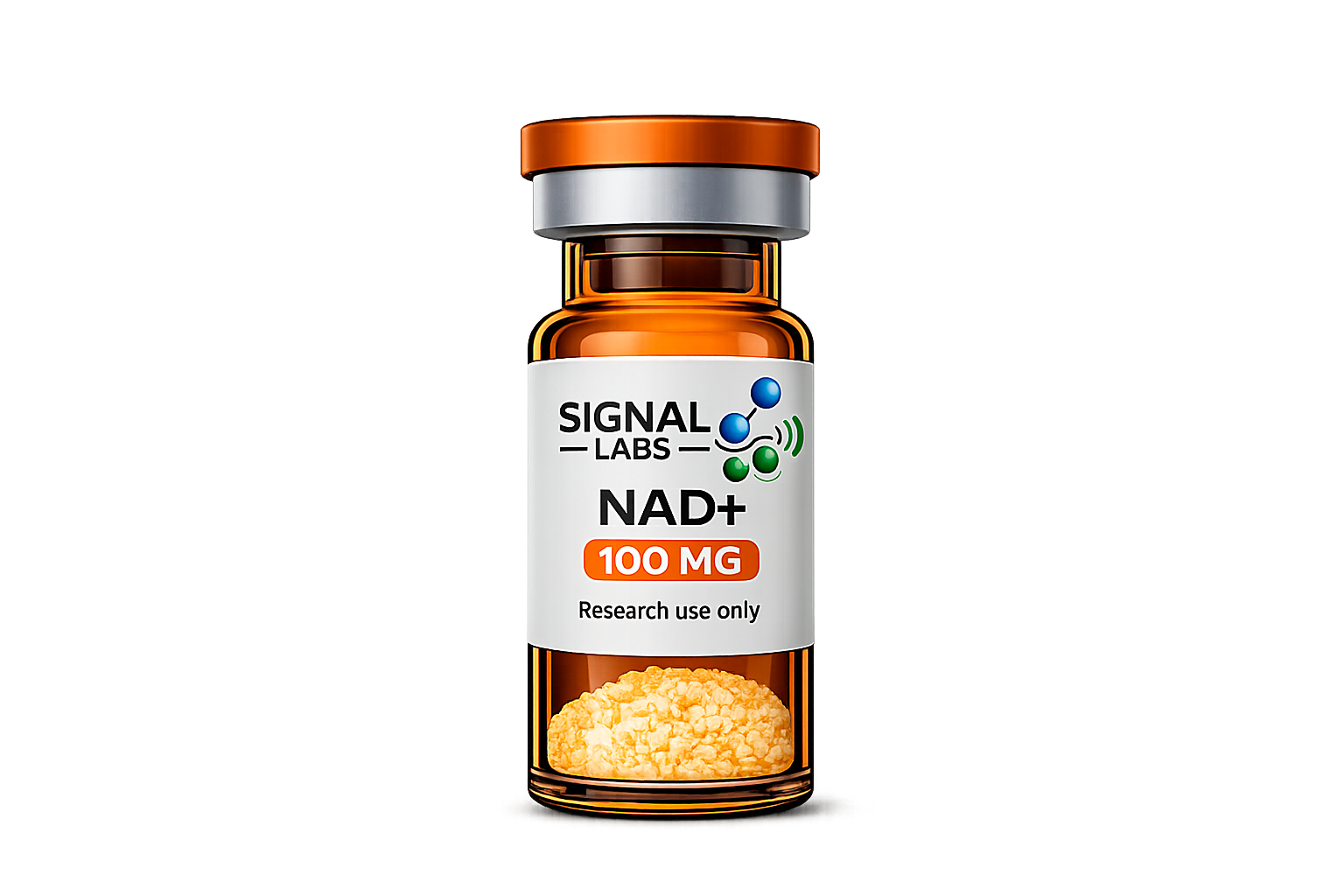
NAD+: Cellular Energy Metabolism and Research Applications
Nicotinamide Adenine Dinucleotide (NAD+) is a coenzyme present in every living cell and arguably the most central molecule in cellular energy metabolism. Discovered in 1906, it has been studied for over a century, with substantial renewed interest following discovery of its role as a substrate for sirtuins and PARP enzymes in cellular ageing and DNA repair biology.
Chemical and Molecular Data
| Property | Value |
|---|---|
| Molecular formula | C21H27N7O14P2 |
| Molecular weight | 663.43 g/mol |
| CAS number | 53-84-9 |
| Structure | Dinucleotide: nicotinamide + adenosine linked by pyrophosphate |
| Forms | NAD+ (oxidised), NADH (reduced) |
| Purity | greater than or equal to 98% as verified by HPLC |
| Form | Lyophilised powder |
| Solubility | Highly water soluble |
| Storage | -20 degrees C in desiccated environment, protected from moisture and light |
| Reconstitution | Sterile water recommended |
| Special note | Highly hygroscopic, handle in dry conditions |
NAD+: Central Metabolic and Regulatory Roles
Molecular Structure and Redox Function
NAD+ is a dinucleotide consisting of nicotinamide ribonucleotide and adenosine connected by a pyrophosphate bridge. The nicotinamide ring is the redox-active component, accepting a hydride ion during biological oxidation to become NADH. The adenosine moiety anchors NAD+ within enzyme binding pockets via the conserved Rossmann fold, one of the most ancient protein structural motifs.
NAD+ and NADH are central to glycolysis, the TCA cycle, and oxidative phosphorylation. NADH donates electrons to Complex I of the mitochondrial electron transport chain, driving ATP synthesis, the primary route for aerobic energy production.
Sirtuin Research
The discovery that sirtuins require NAD+ as a co-substrate, consuming it rather than merely binding it, transformed NAD+ from a metabolic molecule into a regulatory hub.
SIRT1 is extensively studied in metabolic regulation, deacetylating PGC-1alpha to promote mitochondrial biogenesis and deacetylating p53 in stress response. SIRT1 activity directly links cellular energy status to transcriptional regulation.
SIRT3 is the primary mitochondrial sirtuin, activating multiple OXPHOS components and antioxidant enzymes. It is studied in mitochondrial function, ROS management, and metabolic disease models.
SIRT6 is studied in DNA repair, telomere maintenance, and hepatic glucose and lipid metabolism.
The NAD+/sirtuin axis connects directly to MOTS-c research (AMPK/PGC-1alpha signalling) and SLU-PP-332 (ERR receptor activation downstream of PGC-1alpha, itself regulated by SIRT1 in an NAD+-dependent manner).
PARP Enzymes and DNA Repair
PARP1 is activated by DNA strand breaks and consumes NAD+ to generate poly-ADP-ribose chains on target proteins, recruiting DNA repair factors. Excessive PARP activation during oxidative stress can deplete cellular NAD+, studied in ischaemia-reperfusion injury and oxidative DNA damage models.
CD38 and Age-Related NAD+ Decline
CD38 is a glycohydrolase whose expression increases with ageing and inflammation. Research has implicated rising CD38 activity in the age-associated decline in tissue NAD+ levels, a key area of ageing biology research.
NNMT and NAD+ Precursors
NNMT consumes nicotinamide, a direct NAD+ precursor, diverting it away from the NAD+ salvage pathway. 5-Amino-1MQ, a selective NNMT inhibitor, is studied in this context as a means to redirect nicotinamide towards NAD+ biosynthesis.
Research Applications
NAD+ is used as a tool compound and substrate in sirtuin enzyme activity assays (fluorometric and mass spectrometry-based), PARP activity and DNA repair research, cellular redox state measurement (NAD+/NADH ratio assays), mitochondrial respiration studies, age-related metabolic change models, and NNMT inhibitor research in conjunction with 5-Amino-1MQ.
Storage and Handling
NAD+ is highly hygroscopic. Equilibrate sealed vials to room temperature before opening. Prepare stock solutions in sterile water and store at -80 degrees C if not using immediately. Monitor UV absorbance at 340 nm (NADH) to assess reduction state. Avoid multiple freeze-thaw cycles.
NAD+ Metabolism: Biosynthesis Pathways
| Pathway | Starting material | Key enzyme | Relevance |
|---|---|---|---|
| Salvage pathway | Nicotinamide (NAM) | NAMPT | Primary route in most mammalian cells |
| Preiss-Handler | Nicotinic acid (NA) | NAPRT | Alternative salvage from NA |
| De novo | Tryptophan | IDO / TDO | Liver-dominant; kynurenine pathway |
| NMN pathway | NMN | NMNAT1/2/3 | Direct NAD+ precursor route |
| NNMT diversion | Nicotinamide | NNMT | Competes with salvage (blocked by 5-Amino-1MQ) |
NAD+ Decline with Age: Key Research Data Points
Research across multiple model organisms and human studies has documented consistent age-related NAD+ decline:
- Skeletal muscle NAD+ levels have been reported to decline by approximately 50% from young to elderly human subjects in some studies
- Liver NAD+ content in aged mice has been measured at 20-30% of young mouse levels in several published datasets
- CD38 expression — the primary NAD+ hydrolase — increases with age and with inflammatory stimuli (NFkB-driven), creating a feedback loop where inflammation accelerates NAD+ depletion
- NAMPT enzyme activity declines in some tissues with age, reducing salvage pathway capacity
Frequently Asked Questions
Why is NAD+ described as highly hygroscopic and what does this mean practically?
Hygroscopic compounds absorb water vapour directly from the atmosphere. For NAD+, this means that even brief exposure to humid air can result in absorbed water adding to the apparent mass of the compound, causing errors in weighing and concentration calculations. For laboratory use, researchers should equilibrate sealed vials to room temperature before opening, work in a dry environment, and close containers immediately after dispensing. This property does not affect the molecule's biological activity once dissolved in aqueous solution.
What is the NAD+/NADH ratio and how is it measured in research?
The NAD+/NADH ratio reflects the redox state of the cell. A high ratio indicates an oxidised state (active catabolism); a low ratio indicates a more reduced state. It is measured in research using enzymatic cycling assays, HPLC-based methods, or genetically encoded biosensors (such as Peredox or SoNar). The ratio varies significantly between cellular compartments — the cytoplasmic NAD+/NADH ratio is much higher than the mitochondrial ratio.
How does NAD+ relate to sirtuin research?
Sirtuins (SIRT1-7) are class III histone deacetylases that consume NAD+ rather than merely binding it. For each deacetylation reaction, one molecule of NAD+ is cleaved to produce nicotinamide and O-acetyl-ADP-ribose. Because sirtuins require NAD+ as a co-substrate, their activity is directly linked to cellular NAD+ availability — when NAD+ is depleted, sirtuin activity falls. This makes NAD+ a critical node connecting metabolic state to gene regulation.
Published Research References
For laboratory and analytical research purposes only. Not for human or veterinary use. No dosage or administration guidance is provided or implied.
Related research compounds: 5-Amino-1MQ | MOTS-c | SLU-PP-332
NAD+ Biosynthesis Pathways: Salvage, de Novo, and Preiss-Handler
Understanding NAD+ metabolism is essential context for laboratory research using NAD+ as a tool compound. Three main biosynthetic pathways operate in mammalian cells:
Salvage pathway (most important for NAD+ maintenance): NAMPT (nicotinamide phosphoribosyltransferase) converts nicotinamide to NMN (nicotinamide mononucleotide), which NMNAT1-3 (nicotinamide mononucleotide adenylyltransferase) converts to NAD+. This is the primary pathway for recycling nicotinamide released by sirtuin and PARP reactions. NAMPT is the rate-limiting enzyme — its expression and activity largely determine cellular NAD+ levels. NNMT (inhibited by 5-Amino-1MQ) competes with NAMPT for nicotinamide, diverting it away from NAD+ salvage.
de Novo pathway (from tryptophan): Tryptophan is converted through the kynurenine pathway to quinolinic acid, which QPRT (quinolinate phosphoribosyltransferase) converts to NAAD and then NAD+. This pathway is active primarily in liver and brain, and contributes approximately 10% of total NAD+ synthesis in most tissues.
Preiss-Handler pathway (from nicotinic acid): Dietary nicotinic acid (niacin) is converted to NAAD then NAD+ through NaPRT, NMNAT, and NAD synthetase. This is the original anti-pellagra vitamin B3 pathway and is the basis for high-dose niacin therapy.
PARP Biology and NAD+ Consumption
PARPs (poly-ADP-ribose polymerases, especially PARP1) consume NAD+ during DNA strand break repair. When DNA is damaged by radiation, alkylating agents, or oxidative stress, PARP1 binds DNA breaks and uses NAD+ to synthesise poly-ADP-ribose (PAR) chains on itself and other repair proteins. Each ADP-ribosylation consumes one NAD+ molecule, and PARP1 can synthesise long PAR chains in response to severe damage, consuming enormous quantities of NAD+.
Excessive PARP activation ("PARP hyperactivation") in response to massive DNA damage can deplete cellular NAD+ so rapidly that energy failure and necrotic cell death occur — a mechanism proposed in ischaemia-reperfusion injury and other pathological contexts. Research examining NAD+ in DNA damage contexts studies the relationship between PARP activation kinetics, NAD+ depletion rates, and cell death outcomes. PARP inhibitors (olaparib, niraparib) preserve NAD+ by preventing PARP-mediated consumption — a pharmacological approach relevant to understanding how NAD+ availability influences DNA repair capacity.
Frequently Asked Questions
Why is NAD+ highly hygroscopic and how does this affect research?
NAD+ contains a negatively charged pyrophosphate and multiple hydroxyl groups that hydrogen bond avidly with water molecules. In a powder state, these polar groups rapidly adsorb water from atmospheric humidity, converting the anhydrous powder to a hydrated form that is heavier (higher apparent mass per vial) and potentially less stable. For accurate concentration preparation, researchers should equilibrate sealed vials to room temperature before opening (to prevent condensation from entering), weigh quickly, and dissolve immediately. Karl Fischer water content measurement on a reference sample from the same batch allows correction for water content in concentration calculations.
How does exogenous NAD+ enter cells for research experiments?
NAD+ is membrane-impermeant under normal conditions — the charged dinucleotide cannot passively cross lipid bilayers. Research using extracellular NAD+ examines its effects through: (1) CD38/CD157 ectoenzyme-mediated metabolism on the cell surface to generate cell-permeant ADP-ribose and cyclic ADP-ribose; (2) NMN or NR generated by extracellular NAD+ degradation that then enter cells via nucleoside transporters; (3) receptor-mediated signalling through P2Y or P2X purinergic receptors that recognise extracellular nucleotides. For intracellular NAD+ manipulation, researchers typically use cell-permeant precursors (NMN, NR) or NAMPT-activating compounds rather than NAD+ itself.
Browse all Signal Labs research peptides | Peptide storage guide | Reconstitution guide
NAD plus (NAD+) is increasingly searched by longevity and metabolic researchers using the written-out form. Signal Labs supplies NAD+ as a laboratory grade research compound verified to ≥98% purity by HPLC for analytical and research use only.