
CJC-1295 With DAC Research: Long-Acting GHRH Analogue | Signal Labs
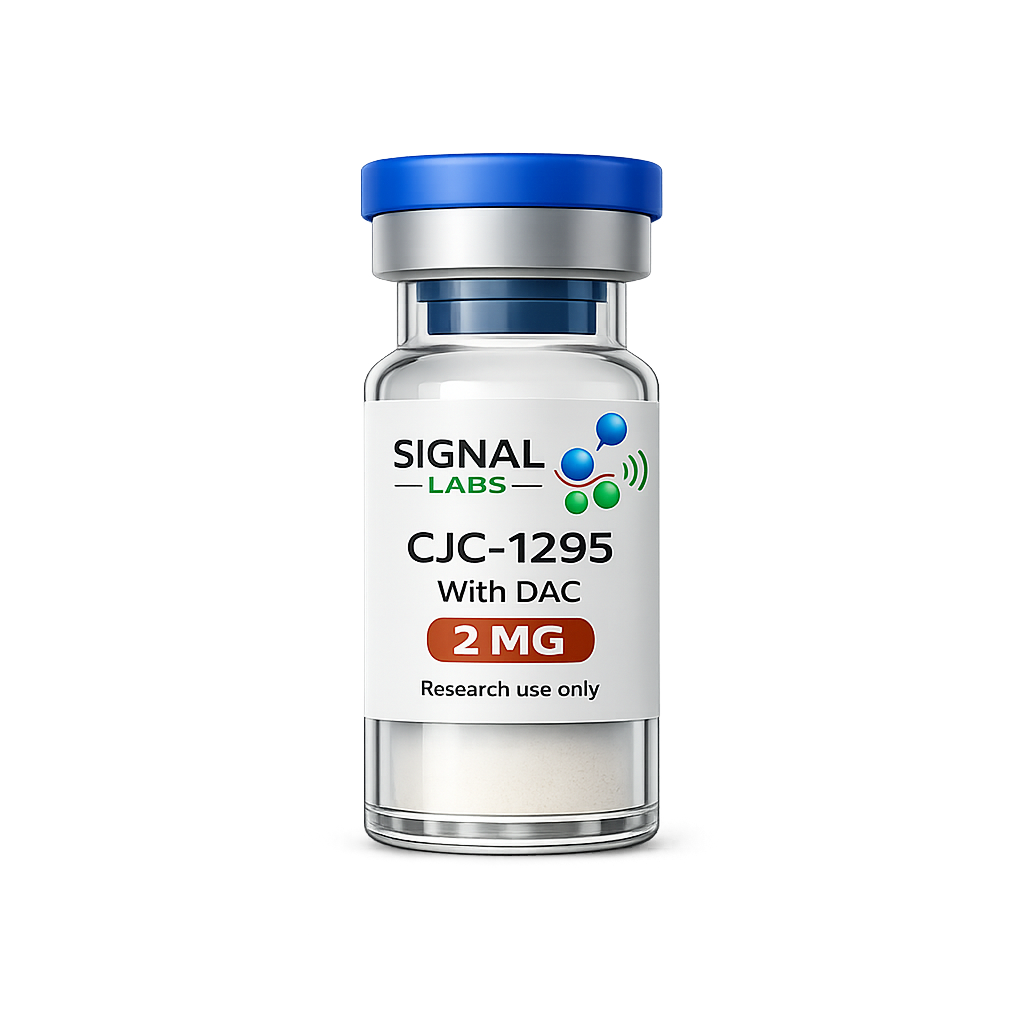
CJC-1295 (With DAC): Long-Acting GHRH Analogue Research
CJC-1295 with DAC is a GHRH analogue incorporating a Drug Affinity Complex (DAC), a reactive maleimidopropionic acid (MPA) group that forms a covalent thioether bond with Cys-34 of endogenous serum albumin. This albumin conjugation extends the compound's plasma half-life from approximately 30 minutes (as seen with CJC-1295 No DAC) to approximately 8 days, enabling sustained GHRH receptor stimulation across extended experimental time frames.
Chemical and Molecular Data
| Property | Value |
|---|---|
| Molecular formula | C165H271N47O46 |
| Molecular weight | 3647.1 g/mol |
| CAS number | 863288-34-0 |
| DAC linker | Maleimidopropionic acid (MPA) |
| Albumin binding | Covalent thioether bond at Cys-34 |
| Effective half-life | Approximately 8 days |
| Purity | greater than or equal to 98% as verified by HPLC |
| Form | Lyophilised powder |
| Storage | -20 degrees C, protected from light and moisture |
| Reconstitution | Bacteriostatic water recommended |
CJC-1295 (With DAC): Albumin Binding — Sustained GHRHR
The Drug Affinity Complex (DAC) Technology
The maleimide group in the MPA linker undergoes thiol-Michael addition with the free thiol of Cys-34 on albumin, the only free (non-disulphide-bonded) cysteine in serum albumin. This covalent bond is stable under physiological conditions. The resulting albumin-peptide conjugate inherits albumin's long half-life through two mechanisms: its large size (above 66 kDa) prevents glomerular filtration, and the neonatal Fc receptor (FcRn)-mediated albumin recycling pathway continuously rescues the conjugate from lysosomal degradation.
This DAC technology achieves covalent albumin binding, distinct from the non-covalent fatty-acid-based albumin binding used in Retatrutide and semaglutide, which rely on hydrophobic interactions.
Sustained vs Pulsatile GHRHR Activation
The fundamental pharmacodynamic distinction between the two CJC-1295 variants is the temporal pattern of GHRH receptor stimulation.
Pulsatile pattern (No DAC version). Discrete GH pulses following each administration, mimicking physiological GH secretion dynamics. Useful for studying pulse-dependent GH biology.
Sustained pattern (With DAC version). Maintained GHRHR activation across days, producing more constant lower-amplitude GH elevation. Enables investigation of tonic GH axis stimulation, receptor regulation, and long-duration IGF-1 responses.
Research has examined whether sustained versus pulsatile GHRHR stimulation produces qualitatively different downstream effects on IGF-1 production, body composition in animal models, and GH receptor expression. This remains an active area of GH axis pharmacology research.
Combined Research with GHS-R1a Agonists
CJC-1295 (With DAC) is frequently studied alongside Ipamorelin (GHS-R1a agonist), a complementary synergistic target. This dual-receptor approach allows investigation of synergistic GH release, and whether long-duration GHRHR activation combined with GHS-R1a agonism produces different outcomes than either compound alone.
Research Applications
CJC-1295 (With DAC) is used in long-acting GHRH analogue pharmacokinetic studies, sustained GH axis stimulation in chronic animal model experiments, comparison with CJC-1295 (No DAC) (pulsatile vs sustained paradigm), GH receptor regulation and desensitisation research, albumin-binding peptide pharmacology as a model system, and IGF-1 axis long-duration studies.
Storage and Handling
Store at -20 degrees C in a desiccated environment, protected from light. Reconstitute with bacteriostatic water. For in vitro studies where albumin binding is not desired, use serum-free medium with freshly reconstituted peptide, as albumin binding occurs rapidly in serum-containing media. Avoid repeated freeze-thaw cycles.
DAC Technology vs Other Half-Life Extension Strategies
| Strategy | Mechanism | Bond type | Half-life extension | Examples |
|---|---|---|---|---|
| DAC (MPA linker) | Covalent albumin binding at Cys-34 | Thioether — irreversible | Up to 8 days | CJC-1295 With DAC |
| Fatty acid conjugation | Non-covalent hydrophobic albumin binding | Reversible | 5-7 days | Semaglutide, Retatrutide |
| PEGylation | Polyethylene glycol chain — steric bulk | Covalent — reversible linkers used | Variable | PEGylated proteins |
| Fc fusion | IgG Fc region — FcRn recycling | Genetic fusion | ~2-3 weeks | Dulaglutide, ACE-031 |
| D-amino acids | Protease resistance | Structural | Moderate | FOXO4-DRI, SS-31 |
Frequently Asked Questions
What happens to the DAC linker in serum-containing media during in vitro experiments?
When CJC-1295 (With DAC) is added to cell culture media containing serum (which contains albumin), the maleimide group immediately reacts with free thiols — primarily Cys-34 of albumin. This means that in standard serum-containing cell culture conditions, CJC-1295 (With DAC) rapidly becomes albumin-conjugated and its free peptide concentration falls dramatically. For in vitro studies where the unconjugated peptide's direct receptor binding is being studied, researchers should use serum-free media and freshly reconstituted peptide, or use the No DAC variant which remains as a free peptide in solution.
Can the sustained GH elevation from CJC-1295 (With DAC) cause receptor desensitisation?
Sustained receptor stimulation is a key research question for the With DAC variant. GHRHRs, like most GPCRs, can undergo desensitisation through beta-arrestin recruitment and receptor internalisation following prolonged agonist exposure. Research has examined whether the sustained GHRHR stimulation from the With DAC version leads to measurable receptor downregulation or functional desensitisation compared to the pulsatile stimulation from the No DAC version. This pharmacodynamic difference between the two variants is itself a subject of ongoing research interest.
Why does CJC-1295 (With DAC) still produce pulsatile GH despite its long half-life?
This counterintuitive finding — that pulsatile GH secretion persists even with sustained GHRHR stimulation — reflects the fundamental pacemaker role of somatostatin in regulating GH pulsatility. GH pulses are determined by the cyclic release of somatostatin from hypothalamic neurons, which periodically suppresses pituitary GH release regardless of GHRHR occupancy. Even with continuous GHRHR stimulation, when somatostatin tone is low, a GH pulse occurs; when somatostatin rises, GH release is suppressed. The published observation that GH pulsatility persists with CJC-1295 treatment has been important in understanding the hypothalamic pacemaker control of GH secretion.
Published Research References
For laboratory and analytical research purposes only. Not for human or veterinary use. No dosage or administration guidance is provided or implied.
Related research peptides: CJC-1295 (No DAC) | Ipamorelin | Retatrutide
View CJC-1295 (With DAC) product page
DAC Technology: Chemistry and Pharmacokinetics
The Drug Affinity Complex (DAC) modification uses maleimidopropionic acid (MPA) as the linking group. MPA contains a maleimide group that undergoes thiol-Michael addition with free thiols — specifically the free thiol of Cys-34 of serum albumin. This is the only non-disulphide-bonded cysteine in human serum albumin, making the conjugation site-specific.
The resulting thioether bond is essentially irreversible under physiological conditions — unlike the non-covalent albumin association used by fatty acid-conjugated peptides (Semaglutide, Tirzepatide, Retatrutide), the CJC-1295 DAC-albumin conjugate does not dissociate. Instead, the peptide is released as albumin itself is catabolised through the FcRn recycling pathway and eventual lysosomal degradation.
This covalent mechanism produces a different pharmacokinetic profile from non-covalent albumin-binding peptides. The effective half-life of CJC-1295 With DAC (~8 days) reflects albumin turnover rather than peptide-albumin dissociation kinetics — a fundamentally different mechanism from the reversible binding of fatty acid-conjugated GLP-1 analogues.
Receptor Desensitisation Research
A key research question for CJC-1295 With DAC versus No DAC is whether sustained versus pulsatile GHRHR stimulation produces measurable receptor desensitisation. GHRHR, like most GPCRs, can be desensitised through GRK (GPCR kinase)-mediated phosphorylation of the intracellular C-terminus, followed by beta-arrestin recruitment and receptor internalisation.
Published research examining pituitary responsiveness to sustained CJC-1295 (With DAC) versus pulsatile GHRHR stimulation has provided somewhat surprising results: GH responses remain robust even with sustained GHRHR occupancy. The counterintuitive maintenance of GH responsiveness has been proposed to reflect the dominant role of hypothalamic somatostatin pacemaker activity in governing GH pulse timing — GHRHR desensitisation may be less prominent than expected because somatostatin withdrawal (not GHRHR reactivation) is the primary driver of each GH pulse.
Research Design: Comparing CJC-1295 Variants
A systematic comparison of CJC-1295 No DAC versus With DAC allows characterisation of how GH pulse pattern (pulsatile vs sustained) affects downstream biology:
Acute GH pulse responses: Use CJC-1295 No DAC to study single-pulse GH release; measure peak GH, duration, and return to baseline.
Chronic sustained GH elevation: Use CJC-1295 With DAC for studies requiring prolonged IGF-1 elevation without repeated dosing.
Desensitisation kinetics: Expose pituitary cells to progressively longer CJC-1295 With DAC incubation and measure cAMP response to acute GHRH challenge as a GHRHR functional reserve indicator.
Frequently Asked Questions
Why does CJC-1295 With DAC still produce pulsatile GH despite its 8-day half-life?
The Ionescu and Frohman (JCEM, 2006) study established that GH pulsatility persists during continuous GHRHR stimulation because GH pulse timing is determined by the hypothalamic somatostatin pacemaker, not by GHRHR activation/deactivation. Somatostatin neurons fire in a rhythmic pattern every 3-4 hours, periodically suppressing GH release regardless of GHRHR occupancy. Between somatostatin pulses, GH is released — and with continuous GHRHR occupancy from CJC-1295 With DAC, these pulses are amplified in amplitude.
Is CJC-1295 With DAC suitable for in vitro research?
For in vitro work, CJC-1295 With DAC requires serum-free conditions for predictable pharmacology. In serum-containing media, the maleimide immediately conjugates to albumin, converting the free peptide to an albumin-bound form that interacts differently with cell surface GHRHR. Use serum-free media and freshly reconstituted peptide, or use CJC-1295 No DAC (which remains as free peptide in all media types) for consistent in vitro results.
Browse all Signal Labs research peptides | Peptide storage guide | Reconstitution guide