
CJC-1295 Without DAC Research: GHRH Analogue Molecular Profile | Signal Labs
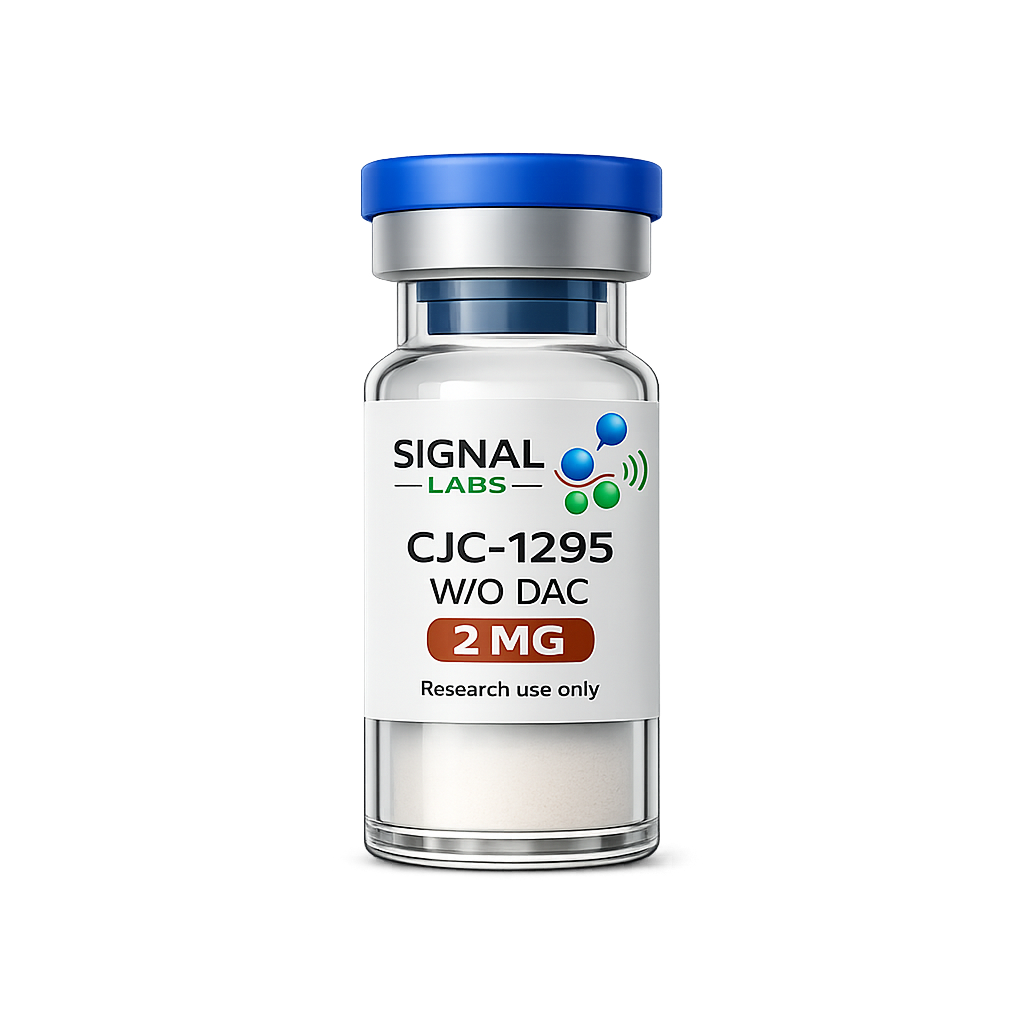
CJC-1295 (No DAC): Modified GHRH Analogue Research Profile
CJC-1295 without DAC, formally known as Modified GRF 1-29 (Mod GRF 1-29), is a synthetic analogue of the first 29 amino acids of endogenous growth hormone releasing hormone (GHRH). Through four targeted amino acid substitutions it achieves substantially improved metabolic stability compared to native GHRH(1-29) while retaining full GHRH receptor (GHRHR) binding and activation capacity.
Chemical and Molecular Data
| Property | Value |
|---|---|
| Molecular formula | C152H252N44O42 |
| Molecular weight | 3367.9 g/mol |
| CAS number | 863288-34-0 |
| Also known as | Modified GRF 1-29, Mod GRF 1-29 |
| Amino acid count | 29 |
| Purity | greater than or equal to 98% as verified by HPLC |
| Form | Lyophilised powder |
| Storage | -20 degrees C, protected from light and moisture |
| Reconstitution | Bacteriostatic water recommended |
CJC-1295 (No DAC): GHRH Analogue — Pulsatile GH
The Four Stabilising Modifications
Native GHRH(1-29) has a plasma half-life under 10 minutes due to rapid cleavage by dipeptidyl peptidase IV (DPP-IV) at the Ala2 position and various endopeptidases. CJC-1295 (No DAC) addresses these vulnerabilities through four amino acid substitutions.
| Position | Native residue | Modified residue | Rationale |
|---|---|---|---|
| 2 | Ala | D-Ala | Blocks DPP-IV cleavage between positions 1-2 |
| 8 | Asn | Gln | Prevents asparagine deamidation |
| 15 | Gly | Ala | Reduces backbone flexibility, improves stability |
| 27 | Met | Leu | Prevents methionine oxidation |
The resulting peptide retains GHRHR binding and activation equivalent to native GHRH(1-29) in receptor binding assays, with significantly extended half-life, making it a more practical research tool than native GHRH for studies requiring defined receptor stimulation over experimental time frames.
GHRH Receptor Pharmacology
The GHRH receptor (GHRHR) is a class B GPCR expressed predominantly on somatotroph cells of the anterior pituitary gland. Class B GPCRs have a characteristically large extracellular domain that participates in ligand binding, well studied in the glucagon/incretin receptor family (relevant to Retatrutide research). GHRHR activation couples to Gs, raising cAMP and activating PKA, leading to GH gene transcription and GH exocytosis.
Pulsatile GH Secretion Research
A key feature of CJC-1295 (No DAC) as a research tool is its short half-life (approximately 30 minutes) relative to CJC-1295 (With DAC). Single administration produces a discrete GH pulse analogous to physiological GH pulses, which occur approximately every 3-4 hours. Research has examined how GH pulse frequency and amplitude influence IGF-1 production, GH receptor expression, and downstream body composition effects, contrasting with sustained GH profiles.
Combined GH Axis Research
CJC-1295 (No DAC) is frequently studied alongside Ipamorelin, which acts at the complementary GHS-R1a receptor. The GHRHR and GHS-R1a represent distinct but synergistic inputs to pituitary GH release. GHRHR (this compound) mediates cAMP/PKA-driven GH synthesis and release, while GHS-R1a (Ipamorelin) mediates IP3/calcium-driven GH release and additionally suppresses somatostatin inhibitory tone. Using both allows investigation of synergistic dual GH axis stimulation.
Research Applications
CJC-1295 (No DAC) is used in GHRHR binding studies and receptor pharmacology, GH pulse physiology research in animal models, comparative pharmacodynamics with CJC-1295 (With DAC), structure-activity relationship (SAR) studies of GHRH analogues, and GH/IGF-1 axis research.
CJC-1295 Variant Comparison
| Property | Native GHRH(1-29) | CJC-1295 No DAC | CJC-1295 With DAC | Tesamorelin |
|---|---|---|---|---|
| Sequence length | 29aa | 29aa (modified) | 29aa (modified) | 44aa (modified) |
| Key modifications | None | D-Ala2, Gln8, Ala15, Leu27 | Same + MPA linker | trans-3-hexenoic acid |
| DPP-IV resistance | No | Yes | Yes | Yes |
| Albumin binding | No | No | Covalent (Cys-34) | No |
| Plasma half-life | Less than 10 min | ~30 min | ~8 days | ~30 min |
| GH pattern | Pulsatile | Pulsatile | Sustained | Pulsatile |
| CAS | 86168-78-7 | 863288-34-0 | 863288-34-0 | 901758-09-6 |
Frequently Asked Questions
Why are there four amino acid modifications in CJC-1295 (No DAC) rather than just protecting position 2?
The four modifications address different degradation vulnerabilities. Position 2 (Ala to D-Ala) blocks DPP-IV cleavage between positions 1 and 2. Position 8 (Asn to Gln) prevents asparagine deamidation — a chemical instability that occurs at Asn-Gly sequences. Position 15 (Gly to Ala) reduces backbone flexibility and improves conformational stability. Position 27 (Met to Leu) prevents methionine oxidation, which would inactivate the peptide on storage. Together these four changes maximise both enzymatic and chemical stability without altering GHRHR binding affinity.
How does CJC-1295 (No DAC) compare to Sermorelin in research?
Sermorelin is GHRH(1-29) without the four stabilising modifications — essentially native GHRH(1-29) with an amidated C-terminus for slight protection. Its plasma half-life is approximately 10-20 minutes, making it less practical as a research tool for sustained receptor stimulation studies. CJC-1295 (No DAC) retains the same GHRHR pharmacology but with approximately three times the half-life, making it a more tractable research tool without the extreme half-life extension of the DAC version.
Is the pulsatile GH pattern from CJC-1295 (No DAC) truly physiological?
The GH pulses induced by CJC-1295 (No DAC) are pharmacological rather than truly physiological — they are triggered by exogenous peptide administration rather than endogenous GHRH neuronal firing. However, the temporal pattern (a discrete GH pulse followed by return to baseline) resembles physiological pulsatile GH secretion, making it more suitable for studying pulse-dependent GH biology than the sustained elevation produced by CJC-1295 (With DAC). For purely pulsatile GH research, combining CJC-1295 (No DAC) with Ipamorelin allows dual-receptor stimulation in controlled pulse experiments.
Published Research References
For laboratory and analytical research purposes only. Not for human or veterinary use. No dosage or administration guidance is provided or implied.
Related research peptides: CJC-1295 (With DAC) | Ipamorelin | BPC-157 | Retatrutide
View CJC-1295 (No DAC) product page
GHRHR Signal Transduction: cAMP Pathway in Detail
CJC-1295 No DAC binding to GHRHR activates the canonical Gs/cAMP/PKA cascade in pituitary somatotrophs. The sequence of molecular events is well characterised:
GHRHR-Gs coupling activates adenylyl cyclase isoforms (primarily AC5 and AC6 in pituitary), raising intracellular cAMP from baseline (approximately 0.1 microM) to peak concentrations of 1-10 microM within seconds of agonist binding. This cAMP elevation activates PKA by dissociating the regulatory subunits (R subunits) from catalytic subunits (C subunits). Free C subunits phosphorylate CREB at Ser133, activating transcription of the GH gene and other cAMP-response element (CRE)-driven genes.
PKA also directly phosphorylates L-type voltage-gated calcium channels (Cav1.2/Cav1.3) at their alpha1 subunits, increasing calcium influx that contributes to secretory granule exocytosis. The combination of cAMP/PKA-mediated gene transcription (longer-term response) and calcium-dependent exocytosis (acute response) together constitute the complete GHRHR-mediated GH secretion programme.
Comparing GHRHR Agonism: Class B GPCR Biology
GHRHR is a member of the class B (secretin receptor) GPCR family — a subfamily that also includes receptors for glucagon, GLP-1, GIP, PTH, VIP, PACAP, and calcitonin. Class B GPCRs share a large N-terminal extracellular domain (ECD) that contributes substantially to ligand binding — the ECD captures the C-terminal portion of the peptide ligand, while the transmembrane domain engages the N-terminal portion of the peptide.
This two-step binding model (ECD captures C-terminus, then N-terminus engages TMD to activate Gs) explains why the first 29 amino acids of GHRH are sufficient for full receptor activity: the GHRH(1-29) N-terminal segment is the activation pharmacophore, while the C-terminal extension of full-length GHRH(1-44) contributes to ECD binding affinity.
DPP-IV Resistance: Why Modifications Matter for Research
CJC-1295 No DAC's four-modification stability strategy addresses a common research limitation: peptide degradation confounding dose-response interpretation. In plasma at 37°C, native GHRH(1-29) (Sermorelin) has a half-life of approximately 10-20 minutes due primarily to DPP-IV cleavage at the Ala2-Asp3 bond. This means that in a 4-hour cell culture experiment, a Sermorelin stock that started at 100 nM effective concentration will have fallen substantially by the end of the assay.
CJC-1295 No DAC's resistance to DPP-IV cleavage maintains more stable effective concentrations across the assay period, producing more consistent and reproducible dose-response relationships. For researchers comparing GH responses to GHRH versus GHRP (using Ipamorelin), using CJC-1295 No DAC rather than Sermorelin eliminates differential stability as a confounding variable.
Frequently Asked Questions
Can CJC-1295 No DAC be used in serum-containing cell culture media?
Yes, unlike CJC-1295 With DAC (which would immediately conjugate to albumin in serum-containing media), CJC-1295 No DAC remains as a free peptide in serum-containing conditions. Its DPP-IV resistance means it maintains more stable concentrations than Sermorelin in serum. For precise concentration control, serum-free defined media eliminates albumin and proteolytic variability.
What cell lines are used for GHRHR pharmacology research?
Primary pituitary cell cultures from rodents (rat anterior pituitary cells) express endogenous GHRHR and are the gold standard for GHRHR pharmacology. For recombinant receptor studies, HEK293 cells stably expressing human GHRHR are widely used, with cAMP accumulation (HTRF or AlphaScreen assays) as the primary functional readout. GH3 rat pituitary adenoma cells express GHS-R1a but minimal GHRHR, making them useful for Ipamorelin but not CJC-1295 research.
Browse all Signal Labs research peptides | Peptide storage guide | Reconstitution guide
CJC 1295 No DAC (also referred to as CJC1295 without DAC or Modified GRF 1-29) is frequently searched by researchers using the space-separated format CJC 1295. Signal Labs supplies CJC-1295 No DAC as an HPLC verified research peptide for laboratory and analytical research purposes.