
BPC-157 Research: Molecular Profile, CAS Number and Laboratory Use | Signal Labs
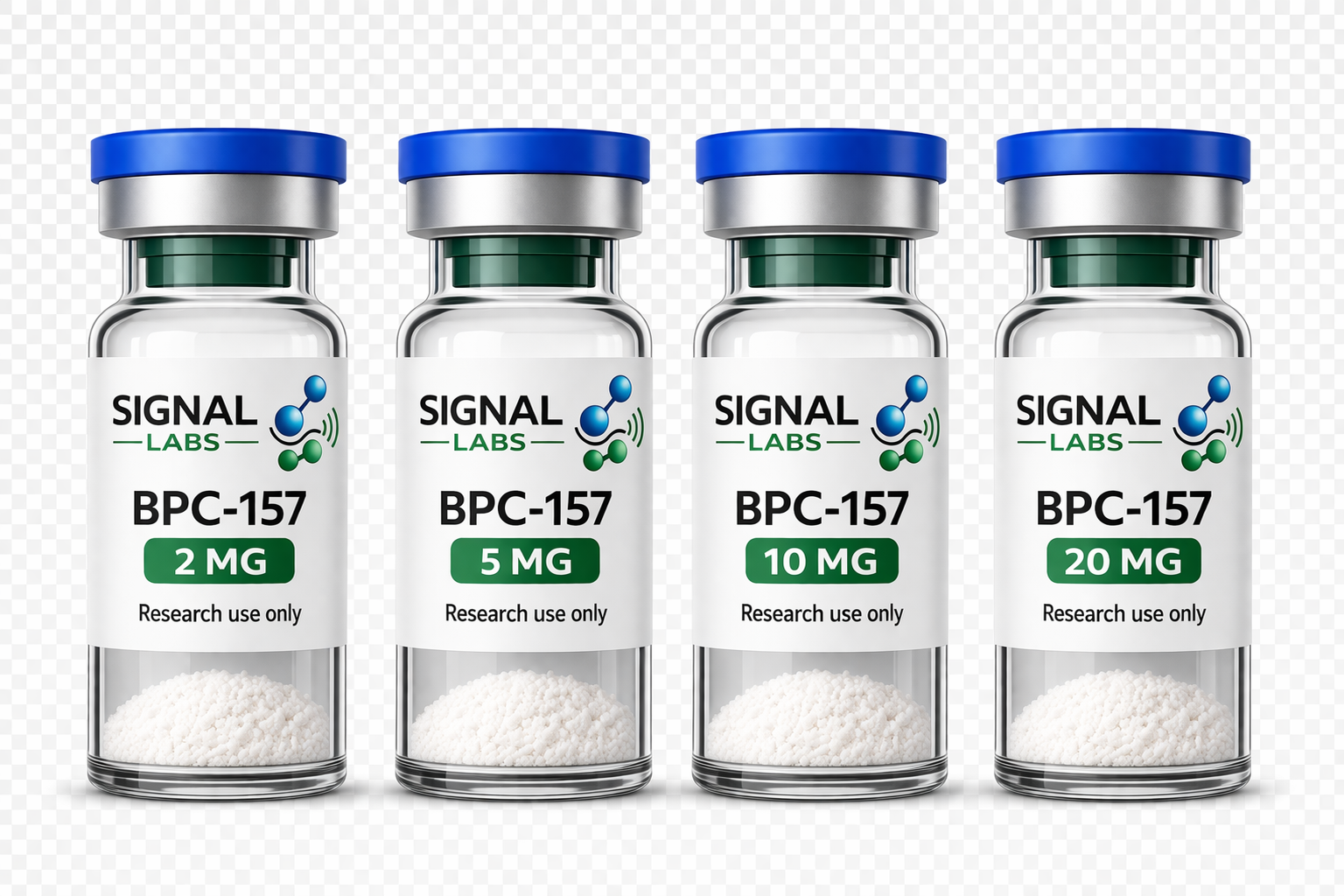
BPC-157: Molecular Profile and Laboratory Research Overview
BPC-157 (Body Protection Compound-157) is a synthetic pentadecapeptide consisting of 15 amino acids. First identified as a partial sequence of the human gastric juice protein BPC, it has become one of the most extensively studied peptides in preclinical research. Its stability in human gastric juice distinguishes it from most endogenous peptides, which degrade rapidly under similar conditions.
Chemical and Molecular Data
| Property | Value |
|---|---|
| Molecular formula | C62H98N16O22 |
| Molecular weight | 1419.56 g/mol |
| CAS number | 137525-51-0 |
| Sequence | Gly-Glu-Pro-Pro-Pro-Gly-Lys-Pro-Ala-Asp-Asp-Ala-Gly-Leu-Val |
| Amino acid count | 15 |
| Purity | greater than or equal to 98% as verified by HPLC |
| Form | Lyophilised powder |
| Storage | -20 degrees C, protected from light and moisture |
| Reconstitution | Bacteriostatic water recommended |
BPC-157: Key Research Signalling Pathways
Structural Characteristics
BPC-157 contains three consecutive proline residues at positions 3, 4, and 5. Polyproline sequences adopt a distinctive left-handed PPII helical conformation and are resistant to most endopeptidases, contributing significantly to BPC-157's stability in biological media. The C-terminal hydrophobic residues Leu and Val may play roles in membrane interactions in laboratory models.
Nitric Oxide System Research
A substantial body of preclinical research has examined BPC-157's interactions with the nitric oxide (NO) signalling system. The NO pathway regulates vascular tone, inflammation, and tissue repair. Laboratory studies have investigated BPC-157 in the context of both NOS-dependent and NOS-independent NO modulation, including work examining endothelial nitric oxide synthase (eNOS) expression in endothelial cell models.
Growth Factor and Signalling Research
In vitro and animal model studies have examined BPC-157 in relation to several growth factor and signalling pathways.
VEGF (Vascular Endothelial Growth Factor). Cell culture studies have examined associations between BPC-157 treatment and changes in VEGF expression in fibroblast and endothelial cell lines.
EGR-1 (Early Growth Response Protein 1). Research has examined BPC-157's effects on EGR-1, a transcription factor involved in cell proliferation, differentiation, and vascular biology.
FAK-paxillin pathway. Research has investigated BPC-157's influence on focal adhesion kinase (FAK) signalling and its downstream effects on the paxillin scaffolding protein, which plays roles in cell adhesion and migration.
Actin Cytoskeleton and Cell Migration
Laboratory research has examined BPC-157's influence on actin filament organisation and lamellipodia formation in scratch assay models. This connects BPC-157 research to the actin biology studied with TB-500, which is a direct G-actin sequestering peptide.
Dopaminergic Research
BPC-157 has been studied in neurochemistry research, particularly in relation to dopaminergic signalling. Animal model studies have examined BPC-157 in models of dopamine system function, making it a subject of interest in neuropharmacology research.
Research Applications
BPC-157 is used as a tool compound in laboratory settings examining cellular signalling in tissue regeneration models, angiogenesis and vascular endothelial biology, gastrointestinal mucosal physiology research, tendon and ligament cell biology, and neurochemical signalling studies.
It is frequently studied alongside TB-500 (actin dynamics), Ipamorelin (GH axis research), CJC-1295 (No DAC) (GHRH receptor pharmacology), and MOTS-c (mitochondrial signalling).
Storage and Handling
Store at -20 degrees C in a desiccated environment, protected from light. Reconstitute with bacteriostatic water for research use. Avoid repeated freeze-thaw cycles, which can compromise peptide integrity. Freshly reconstituted solutions should be used promptly or stored at 4 degrees C for short-term use.
Comparison: BPC-157 vs Related Research Peptides
| Property | BPC-157 | TB-500 | LL-37 |
|---|---|---|---|
| Amino acids | 15 | 43 | 37 |
| Primary target | NO / FAK-paxillin | G-actin (LKKTET) | Bacterial membrane |
| Key research area | GI / vascular / CNS | Actin dynamics / cardiac | Innate immunity |
| Stability | High (protease resistant) | Moderate | Moderate |
| Solubility | Aqueous | Aqueous | Aqueous |
| CAS | 137525-51-0 | 77591-33-4 | 154947-66-7 |
Frequently Asked Questions
What is BPC-157 in laboratory research?
BPC-157 is a synthetic 15 amino acid pentadecapeptide used as a research tool compound to study signalling pathways involved in tissue biology, vascular function, and neurochemistry. It is supplied as a lyophilised powder for laboratory use and is not approved for human or veterinary use.
What makes BPC-157 stable compared to other peptides?
The three consecutive proline residues at positions 3, 4, and 5 adopt a PPII helical conformation that is resistant to most endopeptidases. This structural feature, combined with the peptide's origin from human gastric juice — an environment with high protease activity — contributes to its unusual metabolic stability in biological research media.
How does BPC-157 relate to the nitric oxide system?
Laboratory studies have investigated BPC-157 in the context of both NOS-dependent and NOS-independent nitric oxide modulation. Research has examined changes in endothelial nitric oxide synthase (eNOS) expression in endothelial cell models following BPC-157 treatment, though the precise molecular mechanism remains an active area of investigation.
How should BPC-157 be stored for laboratory use?
BPC-157 should be stored lyophilised at -20°C in a desiccated, light-protected environment. For reconstitution, bacteriostatic water is recommended. Freshly reconstituted solutions should be aliquoted to avoid repeated freeze-thaw cycles, which can degrade peptide integrity over time.
What concentration is BPC-157 supplied at?
Signal Labs supplies BPC-157 as a lyophilised powder verified at greater than or equal to 98% purity by HPLC. Researchers reconstitute to their required working concentration based on their specific assay requirements.
Published Research References
For laboratory and analytical research purposes only. Not for human or veterinary use. No dosage or administration guidance is provided or implied.
Related research peptides: TB-500 | Ipamorelin | CJC-1295 (No DAC) | MOTS-c
Gastrointestinal Cytoprotection Research
BPC-157's origin as a peptide derived from human gastric juice protein BPC connects it fundamentally to gastrointestinal mucosal research. Published research by Sikiric and colleagues has examined BPC-157 in the context of gastric cytoprotection — the ability of the gastric mucosa to resist damage from ethanol, aspirin, NSAIDs, and corticosteroids in rodent models.
The proposed mechanisms involve both NO-dependent mucosal blood flow preservation (eNOS-mediated NO production maintains mucosal microcirculation) and direct cytoprotective effects on gastric epithelial cells. Research has used gastric mucosal lesion scoring, Evans blue extravasation (measuring mucosal permeability changes), and mucosal blood flow measurement (using laser Doppler flowmetry) as endpoints in BPC-157 gastrointestinal research.
Extended research has examined BPC-157 in lower gastrointestinal biology including: intestinal anastomosis healing (comparing BPC-157 versus vehicle on anastomosis bursting pressure and histological healing endpoints), short bowel syndrome models (measuring intestinal adaptation parameters), and colonic healing after experimental colitis induction with TNBS or DSS.
BPC-157 and the Nitric Oxide System: Detailed Research
The relationship between BPC-157 and nitric oxide (NO) signalling involves both NOS-dependent and NOS-independent routes. In published research, BPC-157 has been administered alongside L-NAME (NOS inhibitor) and L-arginine (NOS substrate) to characterise the NO-dependence of its effects. Some published studies report that BPC-157 effects are partially reversed by L-NAME pre-treatment but persist at reduced magnitude, suggesting NOS-dependent and NOS-independent contributions.
The endothelial NOS (eNOS) pathway is the primary focus: eNOS generates NO from L-arginine using NADPH as an electron donor. BPC-157 research has examined eNOS phosphorylation at Ser1177 (the Akt-mediated activating phosphorylation) and at Thr495 (the inhibitory phosphorylation) in endothelial cell models, providing mechanistic data connecting BPC-157 to the Akt→eNOS→NO signalling axis.
Frequently Asked Questions
How does the Pro-Pro-Pro motif at positions 3-5 contribute to BPC-157's stability?
Three consecutive proline residues form a polyproline II (PPII) helix — a left-handed helical conformation distinct from the more common alpha-helix. PPII helices are highly rigid and present an unusual three-dimensional surface that most endopeptidases cannot engage with their active sites. The combination of PPII rigidity (preventing flexible substrate binding) and the unique surface chemistry (Pro lacks a backbone NH, eliminating one hydrogen bonding site used by many protease active sites) makes the Pro-Pro-Pro region resistant to most endopeptidases. This is why BPC-157 — despite being a 15 amino acid peptide — shows extraordinary stability in biological media compared to most peptides of similar size.
What is the significance of BPC-157's sequence origin from gastric juice?
The human gastric juice environment is one of the most hostile enzymatic environments in the body — highly acidic (pH 1-2) with high concentrations of pepsin and other proteases. Proteins that retain integrity in gastric juice must have exceptional enzymatic resistance. The gastric juice protein BPC from which BPC-157 is derived exists in this environment, suggesting that its partial sequence (including the Pro-Pro-Pro stability element) evolved for protease resistance. This biological origin provides evolutionary context for BPC-157's unusual enzymatic stability, which would be adaptive for any peptide signalling molecule that needed to function in the gastric environment.
Browse all Signal Labs research peptides | Peptide storage guide | Reconstitution guide
BPC 157 UK — Signal Labs supplies BPC-157 (also searched as BPC157 or BPC 157) as one of the most popular research peptides UK researchers rely on for laboratory work. Buy peptides UK from Signal Labs with confidence — every batch is HPLC verified to ≥98% purity before dispatch. Signal Labs is a trusted source for research peptides UK-wide.