
Ace 031 Research
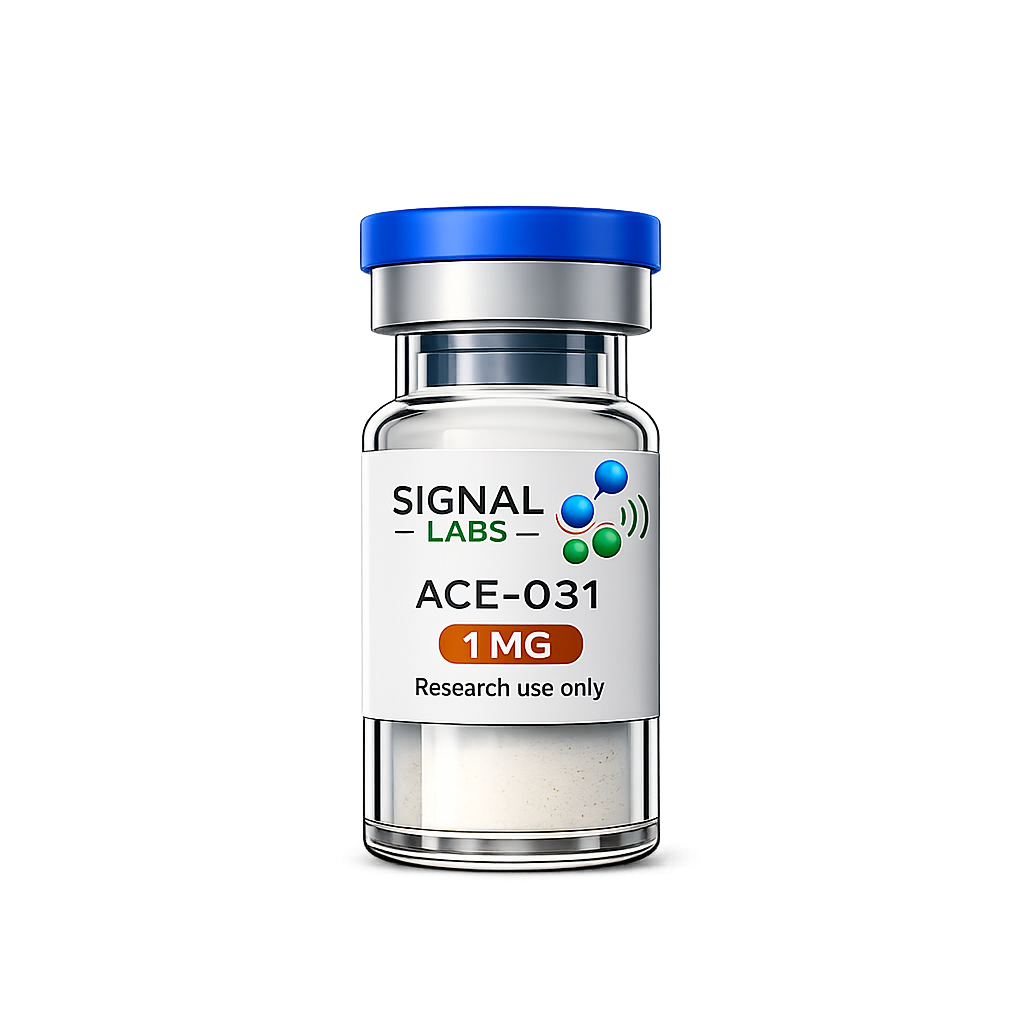
ACE-031: ActRIIB Signalling Research and Muscle Biology
ACE-031 is a soluble form of activin receptor type IIB (ActRIIB) — specifically a fusion protein of the extracellular domain of ActRIIB with the Fc region of human IgG1. It is studied in laboratory settings for its role in myostatin and activin signalling pathway research, including skeletal muscle biology and bone research.
Molecular Data
| Property | Value |
|---|---|
| Molecular weight | Approximately 60 kDa (fusion protein) |
| CAS number | 1260284-89-4 |
| Protein type | ActRIIB-Fc fusion protein |
| Target pathway | Myostatin/ActRIIB/Smad2/3 signalling |
| Purity | greater than or equal to 98% as verified by HPLC |
| Form | Lyophilised powder |
| Storage | -20 degrees C, protected from light and moisture |
| Reconstitution | Bacteriostatic water recommended |
ACE-031: ActRIIB Ligand Trap Mechanism
ActRIIB Biology and Mechanism of Action
Activin receptor type IIB (ActRIIB) is a type II serine/threonine kinase receptor that binds multiple TGF-beta superfamily ligands. The key ligands studied in the context of muscle biology include myostatin (GDF-8) and activin A — both potent negative regulators of skeletal muscle mass that signal through ActRIIB to activate Smad2/3 transcription factors, suppressing muscle protein synthesis and promoting atrophy.
ACE-031 acts as a ligand trap: by presenting the extracellular domain of ActRIIB as a soluble decoy receptor, it competitively inhibits myostatin and activin A from binding endogenous ActRIIB on muscle cells. This prevents Smad2/3 activation and releases the inhibitory brake on muscle protein synthesis.
Myostatin biology. Myostatin (GDF-8) was identified in 1997 as a secreted negative regulator of skeletal muscle growth. Animals with myostatin gene deletions exhibit dramatic muscle hypertrophy. Myostatin signals through a receptor complex of ActRIIB (type II) and ALK4/ALK5 (type I), with Smad2/3 as downstream transcription factors.
Activin A. Beyond myostatin, activin A is also a potent ActRIIB ligand with muscle-inhibitory effects. ACE-031's broad ligand trapping activity (targeting multiple ActRIIB ligands) distinguishes it from myostatin-specific antibodies in research settings.
Follistatin connection. Follistatin is an endogenous inhibitor of myostatin and activins. Research often examines ACE-031 in comparison with follistatin overexpression models or recombinant follistatin treatment to compare the extent and tissue specificity of ligand inhibition.
Bone Biology Research
ActRIIB signalling also regulates bone metabolism. Research has examined ACE-031 in the context of bone mineral density and bone microarchitecture in rodent models, as myostatin and activin signalling influences both muscle and bone simultaneously — reflecting the biomechanical coupling of these tissues.
Research Applications
ACE-031 is used as a research tool in skeletal muscle hypertrophy signalling studies, muscle atrophy model research, myostatin pathway pharmacology, ActRIIB ligand binding assays, bone biology research examining the muscle-bone axis, and TGF-beta superfamily receptor biology.
Myostatin Pathway Inhibition Strategies: Research Tool Comparison
| Approach | Agent | Target | Mechanism |
|---|---|---|---|
| Ligand trap | ACE-031 | Myostatin + Activin A | Soluble ActRIIB decoy receptor |
| Antibody | Anti-myostatin Ab | Myostatin only | Direct ligand neutralisation |
| Follistatin | Recombinant FST | Myostatin + Activins | Endogenous inhibitor protein |
| Receptor antibody | Anti-ActRIIB Ab | ActRIIB receptor | Receptor blockade |
| Gene silencing | siRNA / ASO | Myostatin mRNA | Transcriptional suppression |
Frequently Asked Questions
Why does ACE-031 trap both Myostatin and Activin A rather than just Myostatin?
ACE-031 presents the extracellular ligand-binding domain of ActRIIB as a soluble decoy. ActRIIB is a promiscuous receptor that binds multiple TGF-beta superfamily members — not just Myostatin. By trapping all ActRIIB ligands (including Activin A, GDF-11, and others), ACE-031 provides a broader inhibition profile than Myostatin-specific antibodies. This has both advantages (more complete signalling pathway blockade) and limitations (inability to study Myostatin-specific effects in isolation) as a research tool. Researchers wishing to study Myostatin-specific pharmacology alongside ACE-031 often use Myostatin-neutralising antibodies as comparator compounds.
What is the Smad2/3 pathway and why is it central to ActRIIB research?
Smad2 and Smad3 are transcription factors that act downstream of ActRIIB receptor activation. When Myostatin or Activin A binds ActRIIB, it forms a complex with type I receptors (ALK4 or ALK5), which then phosphorylate Smad2 and Smad3. Phosphorylated Smad2/3 forms a complex with Smad4 and translocates to the nucleus, where it activates transcription of muscle atrophy genes (including Atrogin-1 and MuRF-1) and suppresses genes involved in protein synthesis. ACE-031 prevents this entire cascade by preventing Myostatin and Activin A from reaching endogenous ActRIIB.
How does ACE-031 research relate to IGF-1 LR3 research?
Myostatin/ActRIIB signalling and IGF-1R/PI3K/Akt signalling represent opposing regulatory axes for muscle mass. Myostatin promotes muscle catabolism via Smad2/3; IGF-1 (studied via IGF-1 LR3) promotes muscle anabolism via PI3K/Akt/mTOR and Ras/ERK. Researchers studying muscle biology often investigate both pathways in parallel, making ACE-031 and IGF-1 LR3 complementary research tools for characterising the balance between anabolic and catabolic signalling.
Smad2/3 Pathway: Detailed Molecular Mechanism
When myostatin or activin A binds ActRIIB, it recruits and transactivates type I receptors (ALK4 or ALK5), which then phosphorylate Smad2 at Ser465/Ser467 and Smad3 at Ser423/Ser425 within their C-terminal SSXS motifs. Phosphorylated Smad2/3 forms heteromeric complexes with the common mediator Smad4, and these complexes translocate to the nucleus.
In the nucleus, Smad2/3-Smad4 complexes bind Smad binding elements (SBEs) in the promoters of target genes including:
Atrogin-1 (MAFbx/FBXO32) — an E3 ubiquitin ligase that targets MyoD and eIF3f for proteasomal degradation, reducing myofibrillar protein synthesis and muscle mass. Atrogin-1 is a direct transcriptional target of Smad3 and is upregulated within hours of myostatin stimulation.
MuRF-1 (TRIM63) — an E3 ubiquitin ligase that ubiquitinates and degrades myosin heavy chain, myosin binding protein C, and other sarcomeric proteins. MuRF-1 upregulation drives the breakdown of contractile protein machinery.
MSTN itself — myostatin autoregulates its own expression through Smad2/3 binding sites in the MSTN promoter, creating a positive feedback loop that amplifies catabolic signalling.
ACE-031's ligand trap prevents myostatin and activin A from reaching endogenous ActRIIB, blocking the entire downstream cascade — Smad2/3 phosphorylation, nuclear translocation, and atrogin-1/MuRF-1 upregulation.
Follistatin as a Complementary Research Tool
Follistatin is an endogenous glycoprotein that binds and neutralises multiple TGF-beta superfamily members including myostatin, activin A, activin B, and BMP-2/7. Comparing ACE-031 (ActRIIB extracellular domain trap) with follistatin (endogenous inhibitory protein) in parallel experiments allows researchers to:
- Determine which ActRIIB ligands are responsible for specific biological effects (ACE-031 traps all ActRIIB ligands; specific follistatin isoforms have distinct ligand preferences)
- Study the quantitative contribution of individual ligands (myostatin vs activin A) to ActRIIB-dependent phenotypes
- Compare receptor-level blockade (ACE-031) with extracellular ligand sequestration (follistatin) for downstream signalling effects
Cachexia and Cancer Biology Research
Published research by Zhou et al. (Cell, 2010) demonstrated that ActRIIB antagonism could reverse cancer cachexia and extend survival in tumour-bearing mice — not by affecting the primary tumour but by maintaining muscle mass and metabolic capacity despite ongoing tumour growth. This finding positioned ActRIIB as a research target in cancer cachexia biology, where muscle wasting rather than the primary tumour is often the proximate cause of patient deterioration.
ACE-031 research in cachexia models examines whether ActRIIB ligand trapping — by sequestering the elevated myostatin and activin A levels seen in cancer-associated cachexia — can maintain lean mass, exercise capacity, and metabolic function in tumour-bearing research models.
Published Research References
Key Published Research
Published Research References
For laboratory and analytical research purposes only. Not for human or veterinary use. No dosage or administration guidance is provided or implied.
Related research compounds: IGF-1 LR3 | Tesamorelin | TB-500