
5-Amino-1MQ Research: NNMT Inhibitor and Metabolic Signalling | Signal Labs
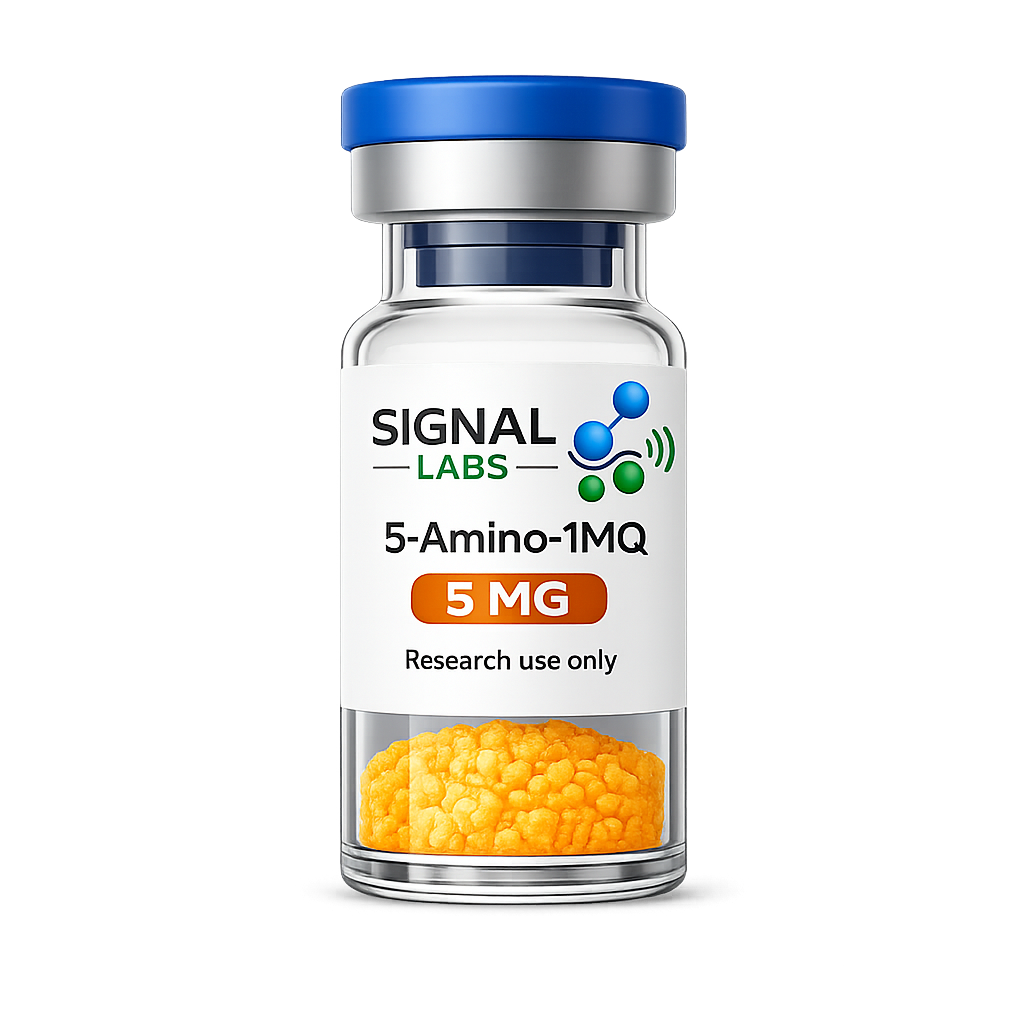
5-Amino-1MQ: Selective NNMT Inhibitor Research and Metabolic Pathways
5-Amino-1MQ (5-Amino-1-methylquinolinium) is a small molecule studied in laboratory settings as a selective inhibitor of nicotinamide N-methyltransferase (NNMT), an enzyme linking NAD+ precursor metabolism, SAM-dependent methylation capacity, and adipose tissue biology.
Chemical and Molecular Data
| Property | Value |
|---|---|
| Molecular formula | C10H11N2+ (cation) |
| Molecular weight | 159.21 g/mol |
| CAS number | 1835656-97-7 |
| Chemical class | Quinolinium salt |
| Target enzyme | Nicotinamide N-methyltransferase (NNMT) |
| Inhibition type | Competitive |
| Purity | greater than or equal to 98% as verified by HPLC |
| Form | Lyophilised powder |
| Storage | -20 degrees C, protected from light and moisture |
| Reconstitution | DMSO recommended for initial stock; dilute in aqueous buffer |
5-Amino-1MQ: NNMT Inhibition and NAD+ Pathway
NNMT Biology and Enzyme Function
NNMT is a cytosolic enzyme expressed at high levels in adipose tissue and liver. It catalyses N-methylation of nicotinamide using S-adenosylmethionine (SAM) as methyl donor, producing 1-methylnicotinamide (MNA) and S-adenosylhomocysteine (SAH). This irreversible reaction diverts nicotinamide away from the NAD+ salvage pathway, where NAMPT would otherwise convert it to NMN, a direct NAD+ precursor.
Structural Basis of Inhibition
5-Amino-1MQ achieves NNMT inhibition through structural mimicry of the nicotinamide substrate. The quinolinium ring system resembles the pyridinium ring of nicotinamide, allowing competitive occupancy of the enzyme active site. Two key structural features drive selectivity: the N-methyl group at position 1 mimics the product geometry within the NNMT active site, and the amino group at position 5 forms additional hydrogen bond interactions with active site residues unavailable to native nicotinamide.
NAD+ Precursor Pathway
By blocking NNMT-mediated nicotinamide catabolism, 5-Amino-1MQ increases nicotinamide availability for conversion to NMN and subsequently NAD+ via the salvage pathway. This has made 5-Amino-1MQ a research tool of interest in NAD+ metabolism studies, often used in conjunction with direct NAD+ supplementation research. The connection between NNMT inhibition and NAD+ biology places 5-Amino-1MQ research in the broader framework of sirtuin activation and connects further to MOTS-c research (mitochondrial NAD+ metabolism and AMPK signalling).
SAM Methylation Economy
SAM is the universal methyl donor for DNA methylation, histone methylation, RNA methylation, neurotransmitter synthesis, and phosphatidylcholine synthesis. NNMT consumes significant quantities of SAM in metabolically active tissues. Inhibition of NNMT with 5-Amino-1MQ preserves SAM for these other methylation reactions. Research has examined how altered SAM availability following NNMT inhibition affects histone methylation patterns, specifically H3K4 methylation, and downstream gene expression in adipocyte models.
Research Applications
5-Amino-1MQ is used in NNMT enzyme inhibition kinetics studies (IC50 determination, competitive inhibition analysis), adipocyte differentiation and lipid accumulation models, NAD+ metabolomics studies examining nicotinamide flux, methylation pathway research (histone methylation, one-carbon metabolism), and SAM/SAH ratio measurements in cell and tissue models.
Storage and Handling
Prepare stock solutions in DMSO (typically 10-100 mM) and store as aliquots at -20 degrees C. Dilute freshly prepared stock in aqueous buffer immediately before use; maintain DMSO at 0.1% or less in cell assays. The quinolinium salt form is stable in solution at physiological pH.
NNMT Inhibitor Comparison
| Property | 5-Amino-1MQ | JBSNF-000088 | NMU-27 |
|---|---|---|---|
| Chemical class | Quinolinium salt | Quinoline | Isoquinoline |
| Inhibition type | Competitive | Competitive | Mixed |
| NNMT selectivity | High | Moderate | Moderate |
| Cell permeability | Yes | Yes | Limited data |
| CAS | 1835656-97-7 | — | — |
Frequently Asked Questions
Why does NNMT matter in metabolic research?
NNMT is expressed at high levels in white adipose tissue and liver, where it consumes large quantities of nicotinamide — diverting it away from NAD+ synthesis — and SAM, reducing the methyl donor pool for DNA and histone methylation. High NNMT activity is associated with obesity in several published datasets, and inhibiting NNMT in preclinical models has been studied as a means of redirecting nicotinamide toward NAD+ biosynthesis while simultaneously preserving SAM for methylation reactions.
How does 5-Amino-1MQ differ structurally from nicotinamide?
Both 5-Amino-1MQ and nicotinamide contain a pyridine-like ring system. 5-Amino-1MQ's quinolinium structure (a bicyclic aromatic system with a quaternary nitrogen) resembles the pyridinium form of nicotinamide — the form that sits in the NNMT active site. The N-methyl group at position 1 mimics the product (1-methylnicotinamide) geometry within the enzyme, while the amino group at position 5 makes additional hydrogen bond contacts with active site residues that nicotinamide cannot access, providing selectivity.
What solvent should be used to prepare 5-Amino-1MQ stock solutions?
DMSO is recommended for initial stock solution preparation, typically at 10-100 mM. When diluting into aqueous assay media, maintain DMSO concentration at 0.1% or lower to minimise solvent effects on cell viability and enzyme activity. The quinolinium salt form is stable in DMSO at -20°C for extended periods when stored as aliquots.
How does 5-Amino-1MQ research connect to NAD+ and sirtuin biology?
By blocking NNMT, 5-Amino-1MQ increases the availability of nicotinamide for the NAMPT-mediated salvage pathway that produces NAD+. More cellular NAD+ means greater substrate availability for sirtuins — which require NAD+ as a co-substrate — and for PARP DNA repair enzymes. This creates a mechanistic link between NNMT inhibition and downstream sirtuin activity, connecting 5-Amino-1MQ research to NAD+ and SLU-PP-332 biology.
NNMT Inhibition and the Methyl Donor Economy
Beyond NAD+ precursor redirection, 5-Amino-1MQ's inhibition of NNMT has a second important metabolic consequence: preservation of the cellular SAM (S-adenosylmethionine) methyl donor pool. NNMT catalyses the methylation of nicotinamide using SAM, producing 1-methylnicotinamide and S-adenosylhomocysteine (SAH). SAH is a potent product inhibitor of SAM-dependent methyltransferases — high SAH concentrations inhibit DNA methyltransferases (DNMTs), histone methyltransferases (HMTs), and RNA methyltransferases.
By blocking NNMT, 5-Amino-1MQ prevents the consumption of SAM for nicotinamide methylation, preserving the SAM/SAH ratio and relieving product inhibition of downstream methyltransferases. Published research has examined whether NNMT inhibition restores histone methylation marks — particularly H3K4me3 (associated with active gene transcription) and H3K27me3 (associated with gene silencing) — in adipocyte models where NNMT is highly expressed.
This epigenetic connection makes 5-Amino-1MQ research relevant not only to NAD+ biology (via nicotinamide salvage) but also to the broader field of epigenetic regulation and gene expression control through methylation pathway manipulation.
Adipose Tissue NNMT: Why Location Matters
NNMT expression is not uniform across tissues. It is expressed at particularly high levels in white adipose tissue (WAT), liver, and skeletal muscle — precisely the metabolically active tissues relevant to obesity and insulin resistance research. Published datasets examining human adipose tissue gene expression in lean versus obese individuals have found positive correlations between NNMT expression and metabolic dysfunction markers.
This tissue-selective high expression makes adipose tissue the primary model system for 5-Amino-1MQ research. In differentiated 3T3-L1 adipocytes (the standard adipocyte model) and primary murine adipocytes, NNMT expression can be quantified by RT-PCR and Western blot, and 5-Amino-1MQ's effects on NNMT activity can be measured by quantifying 1-methylnicotinamide production (by LC-MS/MS) or nicotinamide consumption.
Connecting NNMT Inhibition to SLU-PP-332 Research
The NAD+-ERR-PGC-1alpha axis creates a direct mechanistic connection between 5-Amino-1MQ and SLU-PP-332 research. NNMT inhibition redirects nicotinamide to NAD+ biosynthesis via NAMPT. Higher NAD+ availability increases sirtuin activity (particularly SIRT1). SIRT1 deacetylates and activates PGC-1alpha. PGC-1alpha then co-activates ERR receptors (the target of SLU-PP-332) to drive mitochondrial biogenesis and oxidative metabolism gene expression.
Running 5-Amino-1MQ and SLU-PP-332 in parallel or combination research allows investigation of whether NNMT inhibition-driven NAD+/SIRT1 activation synergises with direct ERR agonism for mitochondrial biogenesis endpoints.
Published Research References
Additional Published Research
Published Research References
For laboratory and analytical research purposes only. Not for human or veterinary use. No dosage or administration guidance is provided or implied.
Related research compounds: NAD+ | MOTS-c | SLU-PP-332